


TL;DR
Capital projects have invested heavily in schedules, cost systems, document controls and digital reporting. Yet Accenture’s recent research found a wide separation between leadership confidence and field experience.
The problem is not simply missing information. It is the time and context lost as execution signals move from the workface into formal project controls.
Closing that gap requires an execution model that connects constraints, commitments, decisions and changing field conditions to the systems that govern the project. Those systems should remain authoritative. The missing capability is a faster, traceable path between what the site knows and when the organization can act on it.

The industry has invested. Something is still breaking.
Capital projects are not short of systems.
Schedules establish the controlled plan. Cost platforms manage budgets, commitments and actuals. Document systems preserve approved information. Reporting processes give leaders a structured view of progress and risk.
Each of those functions matters. Yet a project can have a current schedule, reconciled cost report and governed document repository while still moving towards a problem that none of them shows clearly enough.
A recent Accenture research report gives this problem a useful name: the capital projects execution gap.
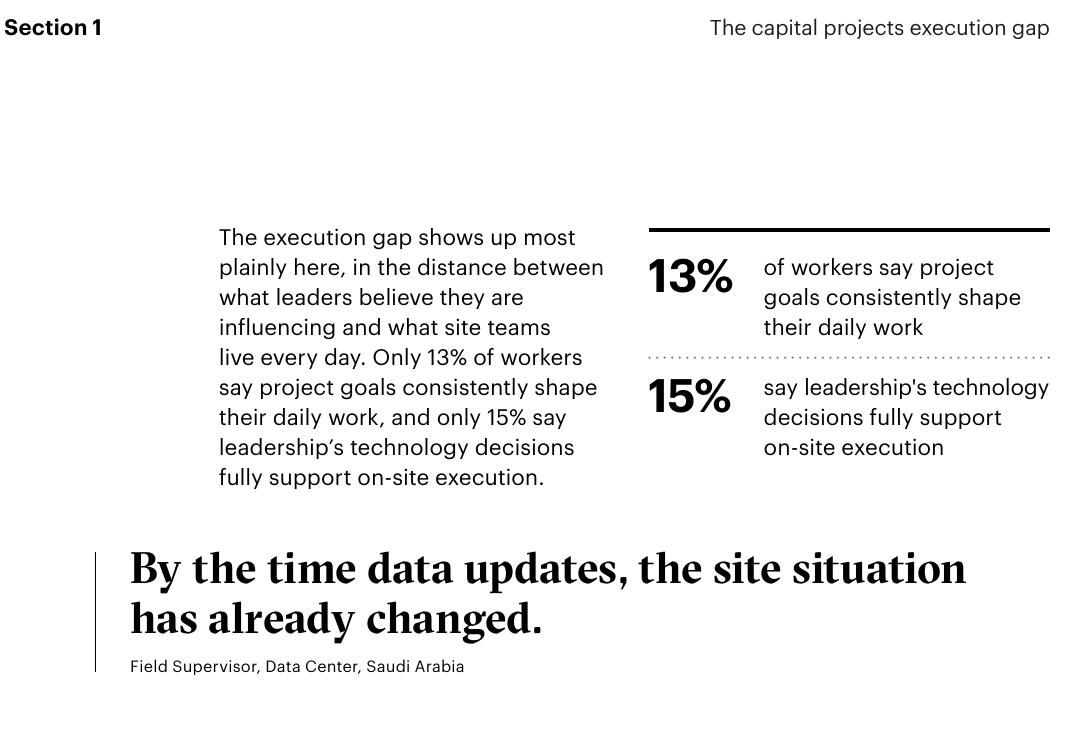
Based on surveys of 700 senior leaders and 350 frontline and site-based professionals, Accenture found that 73% to 77% of senior leaders believe they positively influence cost, planning and schedule performance. Only 13% of frontline workers say project goals consistently shape their daily work. Just 15% say leadership’s technology decisions fully support execution on site.
The two surveys were conducted at different times and use different questions, so Accenture correctly describes the comparison as directional rather than statistically equivalent. Even with that qualification, the underlying message deserves attention.
Leadership intent is losing force before it reaches the work.
Project reality changes between reporting cycles
A controlled schedule may be accurate when it is updated. Execution does not wait for the next update.
A contractor discovers a constraint. An engineering deliverable moves. A predecessor is physically complete but has not been accepted. Two teams need the same workface. Equipment becomes unavailable. A commitment made during a coordination meeting changes what can realistically happen next week.
These are ordinary project events. They frequently appear first in conversations, lookahead plans, meeting notes, spreadsheets, planning boards, photographs and individual follow-ups.
Some eventually become schedule updates, cost forecasts or document revisions. Others are resolved locally. Some lose their original context as they move through meetings and reports. The important variable is time: can the project connect the signal to the right decision before it becomes a delay, a disruption or a retrospective explanation?
That is not an argument against project controls. It is an argument for connecting project controls more closely to execution.

More reporting does not necessarily create earlier warning
When a project lacks current execution context, the natural response is often another report.
But reporting frequency and decision quality are not the same thing.
A weekly report can still contain information gathered through manual follow-up, stripped of the relationships that explain why the situation changed. A dashboard can show that an activity is slipping without preserving the unresolved commitment, approval or interface that produced the movement. A status meeting can identify an issue without connecting it to every downstream activity and team it affects.
Accenture describes three recurring failure modes:
- Signal failure, when field reality is delayed, filtered or lost.
- Value failure, when leadership and site teams optimize for different outcomes.
- Workflow failure, when technology does not match how work unfolds on site.
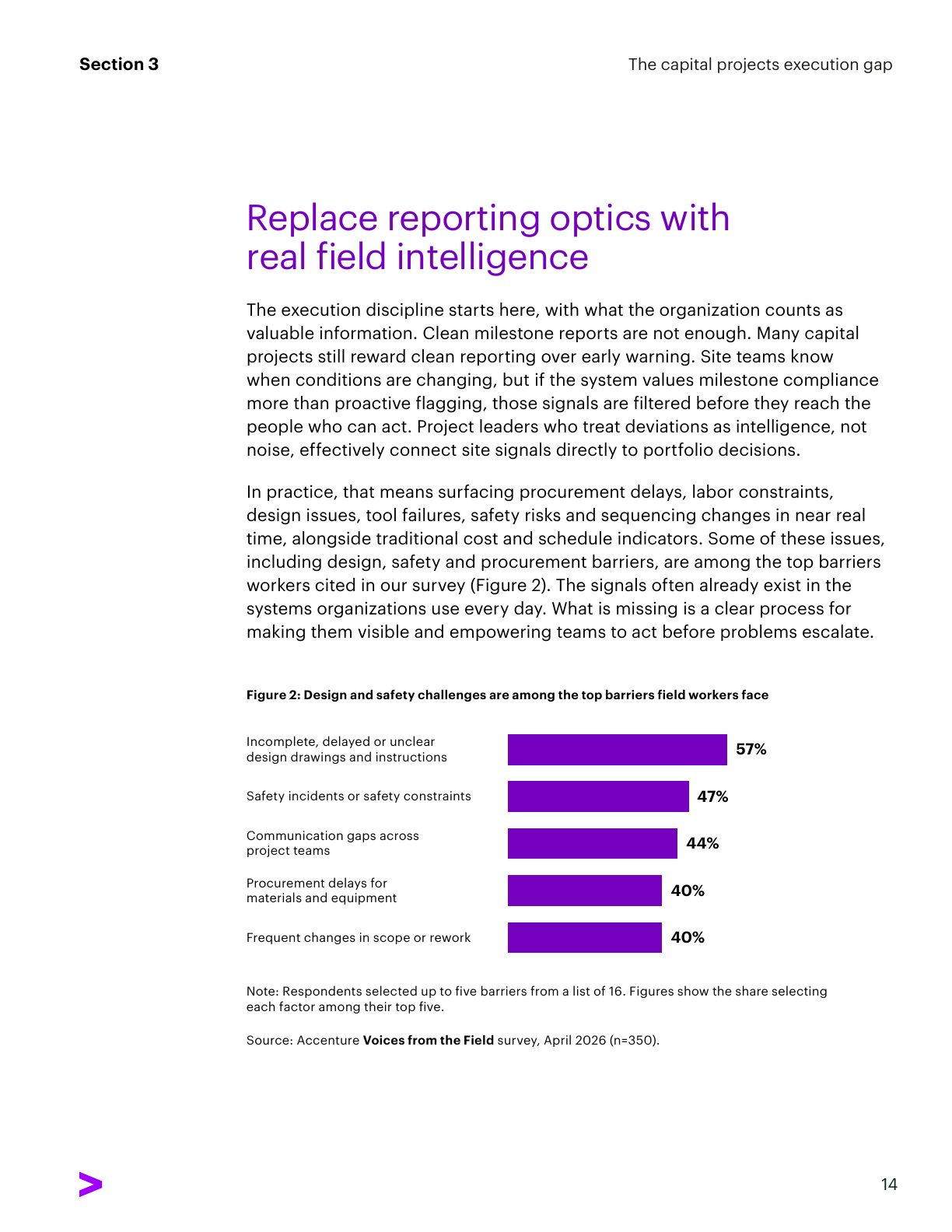
The technology findings are particularly revealing. Fifty-seven percent of surveyed workers identified poor system integration as a top delivery barrier. Fifty-five percent said workflows did not reflect how work happens in practice. Thirty-eight percent said technology did not fit on-site realities.
The problem is not the absence of digital investment. It is the distance between the digital record and the changing conditions around the work.
The control schedule and execution plan have different jobs
Primavera P6 and comparable scheduling systems are designed to govern the project schedule. They model activities, logic, baselines, calendars, milestones and forecast dates. That controlled structure should not be rewritten whenever something changes in the field.
Execution planning operates at another level of detail and cadence.
Teams need to know what work is ready, who owns it, which commitments have been made, what must happen first, what evidence is required and which constraints could prevent the next activity from starting.
Trying to force every operational detail into the control schedule can make the schedule difficult to govern. Leaving that detail in disconnected spreadsheets, cards, inboxes and meetings creates the opposite problem: project controls must reconstruct execution after the fact.
The practical answer is to preserve both levels and connect them.
P6 remains authoritative for the controlled schedule. The execution environment gives teams enough detail to coordinate near-term work and capture what they encounter. Project controls then receives structured information, evidence and context to review through the established governance process.
What an execution model needs to connect
An effective execution model should relate the signals that determine whether planned work can proceed:
- Activities and milestones
- Responsibilities and handoffs
- Commitments
- Constraints
- Decisions and approvals
- Deliverables and required information
- Evidence of progress
- Reasons for variance
- Emerging changes and downstream consequences
These are more useful as a connected network than as separate lists.
A delayed drawing matters because of the procurement package, workface, crew and milestone that depend on it. A missed commitment matters because of the next team waiting for the handoff. A decision matters because it changes what other people should now do.
The relationships provide the context needed for human judgment and responsible use of AI.
Where AI can make a practical difference
AI should not autonomously rewrite the control schedule or remove the scheduler’s authority.
Its more useful role is helping people interpret the growing number of signals around execution.
When activities, decisions, constraints, commitments and evidence remain connected, AI can help identify missing information, summarize changing conditions, trace possible downstream effects and bring emerging issues to the attention of the people responsible for deciding what happens next.
Human roles remain clear. Teams report what they encounter. Project leaders decide how to respond. Schedulers control accepted schedule updates. AI helps them understand the operational context without manually reconstructing it from disconnected records.
This is a more grounded use of AI than producing another management summary from information that is already late.
How Optimality helps close the execution gap
Optimality provides an Operational Intelligence layer around the systems that already govern a project.
It does not need to replace the control schedule, ERP or document repository. Those platforms retain authority for the records they manage.
Optimality connects the operating context between them: activities, people, decisions, commitments, dependencies, deliverables, meetings, evidence and change.
For teams working with Primavera P6, this creates a controlled loop:
- P6 retains the approved schedule, logic, baselines and milestones.
- Relevant scheduled work is translated into a practical execution environment.
- Teams add the activities, constraints, deliverables, decisions and commitments required to make the work ready.
- Progress and evidence are captured closer to where execution happens.
- Project controls reviews structured status and exceptions.
- Accepted updates return to P6 through the project’s established governance process.
The purpose is not to create a competing schedule. It is to shorten the path between execution reality and an informed project decision.
What project leaders should examine
The Accenture research suggests several practical questions for owner-operators and delivery teams:
- How long does it take for a field constraint to reach someone who can resolve it?
- Can the project trace a change from its source to the activities and teams it affects?
- Are commitments recorded with owners, dates and evidence?
- Can project controls distinguish verified progress from an unsupported status update?
- Do teams enter the same information into multiple systems?
- Does AI work from governed operational context or isolated documents and copied reports?
- Can the organization preserve why a decision was made, not merely its final outcome?
These questions reveal whether a project has a reporting process or a functioning execution model.
The next performance advantage is time to understanding
Capital projects already generate the signals needed to anticipate many execution problems. The difficulty is connecting those signals early enough, with enough context, to support action.
The next generation of project technology should therefore be judged by more than the quality of its dashboards.
It should help the organization understand what is changing, why it matters, who is affected and what decision is required while the outcome can still be influenced.
The distance between site knowledge and organizational action may be where project performance is won or lost.
Start connecting the reality between your project systems
Sources
- Accenture, “The Capital Projects Execution Gap,” 5 August 2026
- Download the Accenture research report
- Optimality, “Connect Your Control Schedule to the People Doing the Work”
- Optimality, “How Do You Keep a P6 Control Schedule Aligned With What Is Actually Happening in the Field?”
Research credit: Adam J. Shaw, Jonas Kampik and Alberto Sanz of Accenture.
Keep your systems of record. Add the connected execution context that helps people and AI understand what is happening and what requires attention next.
Begin your 14-day trial with Optimality