



A current schedule can still contain late information
A project director opens the monthly controls pack. The schedule has been updated. Cost actuals have closed. The latest approved documents are in the document system. Every major platform appears to be doing its job.
Yet an engineering decision made ten days earlier has changed a procurement assumption. A downstream construction activity still depends on the original decision. The field team has made a commitment based on information that is technically current in one system and already obsolete in another.
Nothing in this scenario requires the schedule, cost system or document repository to be defective. The problem is the timing and connection of the information around them. Each system can hold an authoritative record while the relationship between those records remains difficult to see.
TL;DR
Capital-project schedules and cost reports can be current while important execution risks remain hard to see. Formal systems record approved plans, progress, financial transactions and controlled documents, but decisions, commitments, document changes, handoffs and emerging dependencies often move through separate teams and tools. Research on major-project delivery consistently points to delayed information, weak coordination, unmanaged change and a shortage of leading indicators as contributors to late intervention. Operational Intelligence connects that surrounding execution context while scheduling, financial and document systems retain authority for their governed records.
A reliable integrated schedule is one of the most important tools available to a capital-project team. The US Government Accountability Office describes it as a model of planned work, dependencies and expected completion dates that can measure performance, assess the effects of change and warn when targets may need adjustment.
That definition matters because it is easy to turn this discussion into a false choice. The schedule is not the problem. Nor is it merely a backward-looking report. A well-built schedule contains forecasts and can reveal the consequences of change.
Its usefulness, however, depends on what enters it. The GAO guidance requires current progress, reliable logic, realistic remaining work and an accurate status date. It also calls for explanations of milestone changes, handoffs, critical paths and the assumptions behind schedule updates. If a decision has not been communicated, a document change has not been connected to affected work, or a commitment has not been updated, the schedule cannot represent that operational fact before the project team does.
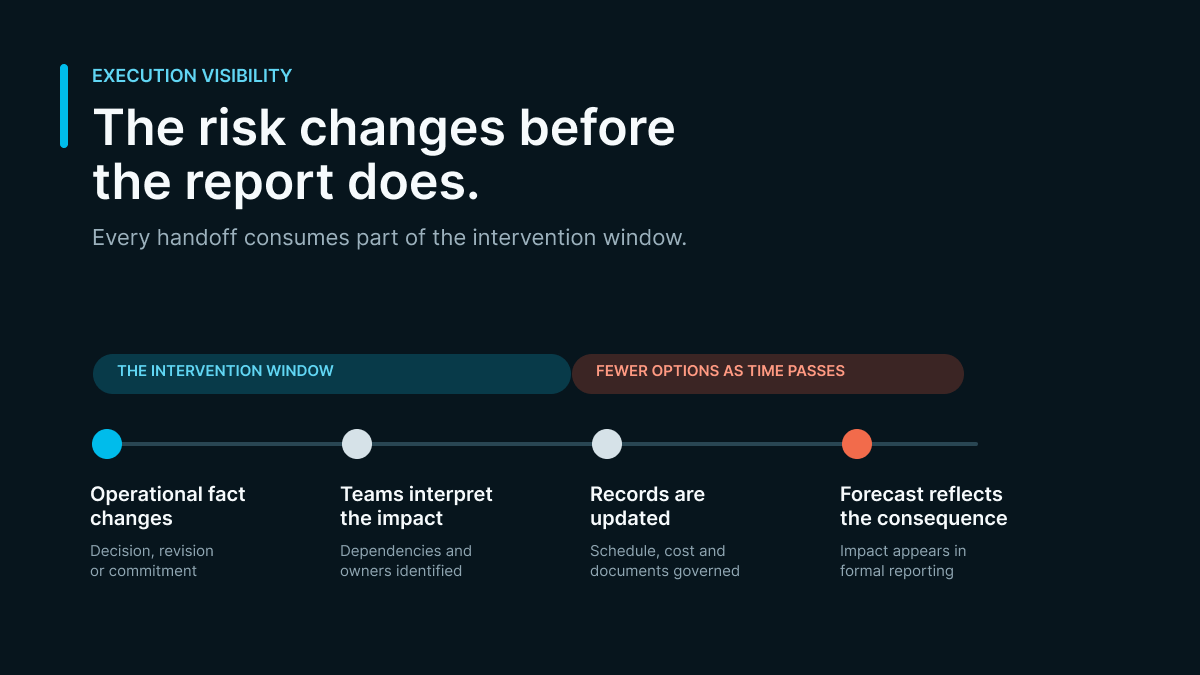
This creates a timing gap. Work changes continuously, but formal records update at different intervals and through different governance processes. By the time an emerging problem is reflected in the schedule, the project may have fewer practical options for avoiding disruption.

Execution risk develops between systems and organizations
Large capital projects distribute work across an owner, EPCs, specialist contractors, suppliers and internal disciplines. Each participant has different responsibilities, systems and reporting needs. The complexity is organizational as much as technical.
McKinsey's research on major-project delivery describes detailed project information scattered across increasingly interdependent delivery networks. Collecting it, integrating it and turning it into decision-ready insight can be difficult. The resulting blind spots leave leaders dependent on information that may arrive late or without the context required for action.2
In a later review, McKinsey reported that news of execution delays can take days or weeks to reach project leaders. Information may be split across contractor systems, recorded inconsistently or delivered at the wrong frequency and level of detail for the person making the decision.3
The practical issue is not simply that data sits in several databases. Different records become meaningful when their relationships are understood.
An approved drawing revision matters to document control. It matters differently to the buyer waiting to place an order, the planner maintaining activity logic, the construction lead assessing readiness and the project director protecting the forecast. A repository can confirm which revision is authoritative. It does not necessarily explain every operational commitment and dependency affected by that revision.
A decision becomes a project impact through dependencies
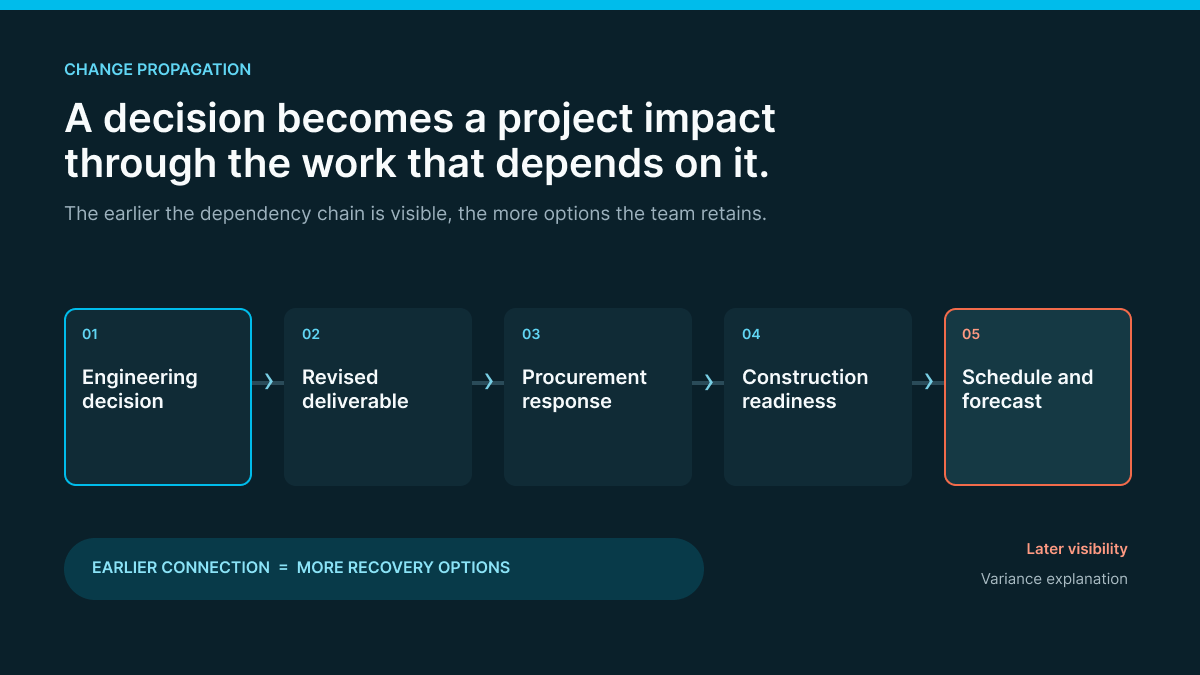
Consider a simplified example. An engineering team changes the specification for a piece of equipment. The revised document is reviewed and approved correctly. Procurement now needs a new vendor response. Installation work may need different access or sequencing. Commissioning assumptions may also change.
The decision itself is not yet a schedule delay. It becomes one through the network of work that depends on it.
The earlier those relationships are visible, the more choices the team retains. Procurement might accelerate a clarification. Construction might resequence accessible work. The planner might test the effect on a near-critical path. A project director might resolve an ownership conflict before it consumes contingency.
If those relationships are reconstructed only during the next reporting cycle, the same issue appears as an explanation for variance rather than an opportunity to prevent it.
Research into fast-track engineering, procurement and construction identified this coordination problem more than two decades ago. The study found value in capturing relationships between deliverables, recording their status and allowing teams to query how disruptions affect connected work.4 The technology has changed considerably since then. The underlying management need has not.
Why more reporting is not the same as earlier warning
Capital projects rarely suffer from a shortage of reports. The harder question is whether those reports reveal the conditions that are likely to affect future work.
The Construction Industry Institute developed a Project Health Indicator for precisely this reason. After front-end planning and risk analysis, much project tracking reverted to traditional measures. CII sought additional indicators that could identify developing problems and mitigation opportunities earlier during execution. Its research grouped 43 leading indicators across areas including alignment, change management, constructability, project controls and team building.5
That work treats leading indicators as a complement to traditional controls. This is the useful distinction. A dashboard that repeats approved dates, posted costs and completed progress may present those records accurately without revealing an unresolved decision or weakening handoff that has not yet changed the numbers.
Earlier warning depends on relationships and accountability. What changed? Which work depends on it? Who owns the response? What commitment has been made? When does the issue become difficult to reverse? Those questions require context around the measures, not simply more measures.

Change rarely stays where it began
The cost of a change depends partly on when teams understand it and how far its effects have travelled. CII's research into project change management found that changes can interrupt workflow, delay activities, increase costs and generate claims. Its guidance emphasizes a shared change process understood by owners, designers and contractors. Systematic reviews of construction research also connect design changes with rework, delay and cost growth, while identifying communication and coordination as recurring factors. Not every change can be predicted, and not every change is harmful. Projects adapt to new information, operating requirements and external conditions. The management problem is allowing a local decision to become a hidden cross-project consequence. An effective operating model should therefore preserve more than the approved change record. It should make the affected commitments, deliverables and dependencies visible to the people responsible for responding.
What Operational Intelligence means for capital projects
Operational Intelligence connects the activities, responsibilities, dependencies, documents, decisions, commitments and organizational knowledge that shape capital-project execution. It helps owner-operators understand how work is progressing, what has changed, what is blocked and what requires attention.
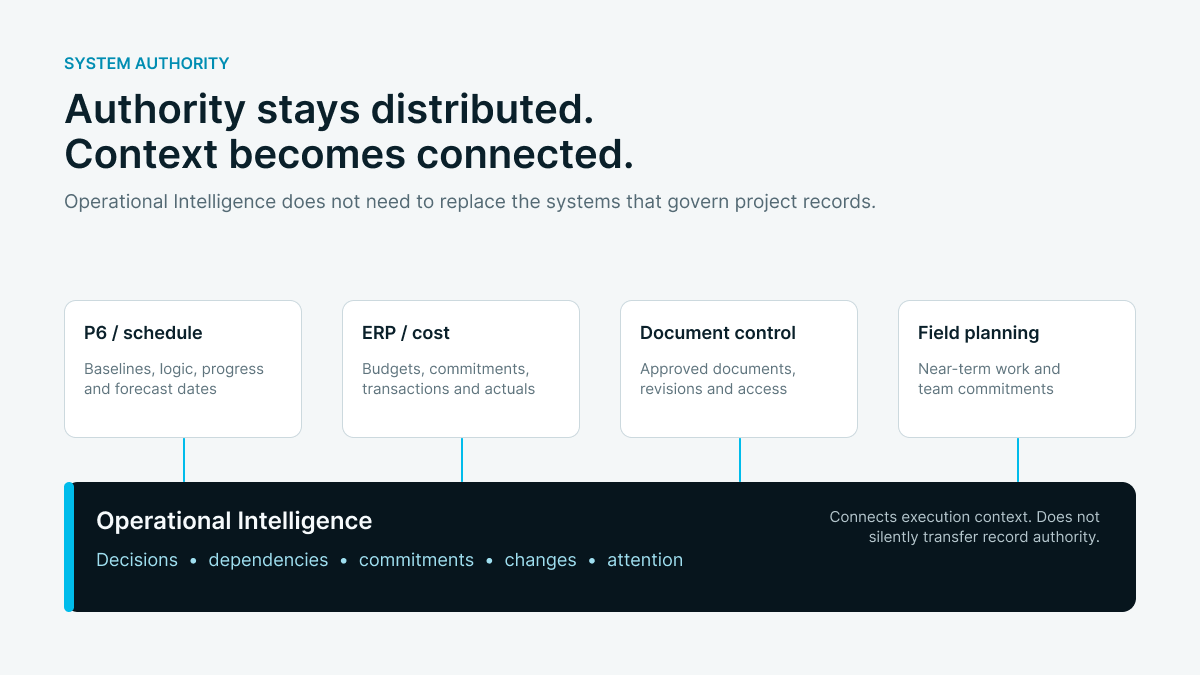
It is different from a scheduling system, a cost-control platform or a document repository because its primary purpose is the connected context surrounding execution. The distinction concerns authority and purpose, not a claim that established platforms lack useful intelligence.
Integrated schedule, including Primavera P6
Authoritative role: schedule baselines, activity logic, status and forecast dates.
Operational question: Which unresolved decision or changing deliverable has not yet been reflected in the schedule?
ERP and cost-control systems
Authoritative role: financial commitments, budgets, transactions and actual costs.
Operational question: What operational dependency is likely to affect a future commitment or forecast?
Document-management systems, including SharePoint
Authoritative role: controlled documents, revisions, access and approval records.
Operational question: Which activities, commitments and teams are affected by the meaning of a document change?
Pull-planning and field-coordination systems
Authoritative role: near-term production plans and field commitments.
Operational question: Which upstream decision or engineering dependency determines whether work is truly ready?
Operational Intelligence
Authoritative role: connected execution context across work, decisions, commitments and evidence.
Operational question: What changed, what depends on it, who owns the response and what requires attention next?
These roles can overlap in a particular implementation. This is a decision model, not a universal product classification.
Operational Intelligence does not remove the need for project discipline
These are not competing explanations. They describe different parts of the project system. Owner-operators need realistic forecasts, clear governance, reliable schedules, disciplined controls and capable teams. Operational Intelligence adds value when it helps those elements remain connected as the work changes.
Connected context cannot rescue an unrealistic business case, an undefined scope or a schedule with broken logic.
CII's research involving more than 600 projects and almost US$37 billion in installed cost found that better-defined projects performed better on cost growth, schedule growth and change orders. The UK Infrastructure and Projects Authority likewise emphasizes early capability, governance, risk allocation and decision-making in setting complex projects up for success.
Forecasts also face human and institutional problems. Bent Flyvbjerg's research identifies optimism bias and strategic misrepresentation as causes of inaccurate project forecasts and proposes reference-class forecasting as one corrective.
What owner-operators should examine
The first step is not buying another dashboard. It is testing how quickly the current operating model turns an emerging fact into a coordinated response.
Ask:
- Can every material execution decision be linked to an accountable owner, the affected deliverables and the work that depends on it?
- Can teams see when a document revision changes a commitment or readiness assumption outside the document system?
- Are unresolved commitments visible before they become schedule status?
- Can an owner trace a developing issue across its own team, EPCs and contractors without reconstructing the story from meetings and email?
- Does the forecast-update process explain the operational cause of a change, or only its eventual numerical effect?
- When experienced people leave, does the reasoning behind important decisions remain available to the next team?
The answers reveal whether the organization has a reporting problem, a governance problem, a coordination problem or some combination of the three.
Where Optimality fits
For the project-controls application, see Capital Project Cost Control: How to Track Commitments and Actual Costs Without Spreadsheet Double-Entry: https://www.optimalitypro.com/resources/capital-project-cost-control-commitments-actual-costs
Optimality can sit alongside established scheduling, financial and document systems. Those systems retain authority for their governed records. For example, P6 can remain authoritative for schedule baselines and an ERP for posted actual costs, while Optimality preserves the operational context needed to understand decisions, changes and emerging execution risk.
The exact data sources, integrations and responsibilities depend on the deployment. The point is not to create another system claiming authority over every record. It is to prevent the context connecting those records from disappearing between teams and reporting cycles.
Optimality, the capital-project Operational Intelligence platform described here, is unrelated to Cadence's Optimality software and to Optimality Theory in linguistics.
For a broader evaluation of the software landscape, read 10 Best Capital Project Management Software Tools (2026 Guide). For the project-controls application, see Capital Project Cost Control: How to Track Commitments and Actual Costs Without Spreadsheet Double-Entry.
Frequently asked questions
What information is commonly missing from cost and schedule reports?
Cost and schedule reports may not preserve the complete reasoning behind decisions, the status of cross-discipline commitments, relationships between changing deliverables or the operational context explaining why progress changed. The exact gap depends on the project's processes and systems. The issue is often the connection between authoritative records rather than the absence of those records.
What is Operational Intelligence for capital projects?
Operational Intelligence connects the activities, responsibilities, dependencies, documents, decisions, commitments and organizational knowledge that shape capital-project execution. It helps owner-operators understand how work is progressing, what has changed, what is blocked and what requires attention while established scheduling, financial and document systems retain authority for their governed records.
How is Operational Intelligence different from project management software?
Project management software commonly plans and tracks scope, schedule, cost, resources or portfolios. Operational Intelligence focuses on the connected context surrounding execution, including how decisions, changes, commitments and dependencies affect work across teams and systems. Product capabilities can overlap, so the distinction is based on operational purpose rather than a rigid software category.
Does Operational Intelligence replace Primavera P6?
Operational Intelligence does not need to replace Primavera P6. P6 can remain authoritative for schedule baselines, activity logic and progress, while an Operational Intelligence platform connects decisions, commitments, documents and dependencies that help teams interpret execution. The appropriate boundary and integration depend on the organization's operating model and deployment.
How can owner-operators identify execution risk earlier?
Owner-operators can identify execution risk earlier by combining a reliable integrated schedule with leading indicators, disciplined change management, clear decision ownership and connected information across the owner, EPCs and contractors. A developing issue should be traceable to affected deliverables, commitments, dependencies and forecast assumptions before its consequences become difficult to reverse.
What is Optimality software?
Optimality is an Operational Intelligence platform for organizations coordinating complex work across teams, disciplines and systems. It connects activities, responsibilities, dependencies, documents, decisions and commitments so teams can understand what has changed, what is blocked and what requires attention. Optimality is designed for capital-project and other complex operating environments.
How does Optimality work with P6, ERP systems and SharePoint?
Optimality can preserve operational context around records governed by P6, ERP systems and SharePoint. P6 can remain authoritative for schedule baselines, an ERP for financial transactions and SharePoint for controlled documents. The precise integrations, data flows and responsibilities depend on the deployment and should be verified for each customer environment.
Why can a capital-project schedule be current while execution risk remains hidden?
A capital-project schedule can be current while an emerging risk remains hidden when the decision, document change, commitment or handoff affecting the work has not yet been translated into schedule logic or progress data. A reliable schedule remains essential, but timely decisions also depend on connected information from engineering, procurement, construction and project controls.
Sources and image attribution
- US Government Accountability Office, GAO Schedule Assessment Guide: Best Practices for Project Schedules, December 2015.
- McKinsey & Company, Better tech for closer tracking of capital projects, 2021.
- McKinsey & Company, Increasing transparency in megaproject execution, August 2023.
- Choo and Tommelein, Geographic Information System for Coordination of Fast-Track Projects, 2002.
- Construction Industry Institute, Leading Indicators during Project Execution, October 2006.
- Construction Industry Institute, Project Change Management, November 1994
- Yap et al., Design Changes in Construction Projects: Causes and Impact on the Cost, 2019.
- Construction Industry Institute, Data Analysis in Support of Front End Planning Implementation, 2006.
- UK Infrastructure and Projects Authority, Project Routemap: Setting up projects for success, updated February 2022.
- Flyvbjerg, From Nobel Prize to Project Management: Getting Risks Right, 2006.
Hero image: Marcus Reubenstein on Unsplash.