



Why AWP and Lean Pull Planning Still Don’t Prevent Project Delays
TL;DR
Advanced Work Packaging (AWP) and Lean Pull Planning are widely recognized as best practices in capital project delivery. Industry research shows they can deliver 10–25% schedule improvements, 5–10% cost savings, and significant gains in execution reliability when implemented effectively.
Yet many projects still fail to achieve these outcomes.
The issue is not the methodologies themselves, but the gap between planning and real-time execution. Until that gap is addressed, much of the potential value will remain unrealized.

The Industry Has Already Solved the Planning Problem
Over the past decade, the capital projects industry has made meaningful progress in how work is planned and coordinated. Frameworks such as Advanced Work Packaging, developed through the Construction Industry Institute, have introduced structure into what was once a fragmented and reactive process.
By defining work packages, aligning deliverables with construction needs, and establishing a logical sequence of execution, AWP provides a disciplined foundation for delivery.
At the same time, Lean Pull Planning - particularly the Last Planner System promoted by the Lean Construction Institute - has improved how work is executed in practice. It brings focus to commitment, constraint removal, and workflow reliability, helping teams move from reactive coordination toward more predictable delivery.
These approaches are not theoretical. Industry bodies such as the Construction Owners Association of Alberta and CII have consistently reported that, when applied effectively, they can materially improve project outcomes. Reported benefits include double-digit improvements in schedule performance, measurable cost reductions, and significant increases in labor productivity.
Lean studies have similarly shown that teams using pull planning can improve Percent Plan Complete (PPC) from baseline levels of around 50-60% to 70–85% or higher, a strong indicator of improved execution reliability.
In other words, the industry is not lacking in methodology. It already understands what good looks like - and what it can deliver.
And yet, the results remain inconsistent.
.webp)
Two Complementary Approaches - Not a Complete Solution
Part of the challenge lies in how these methodologies are understood and applied.
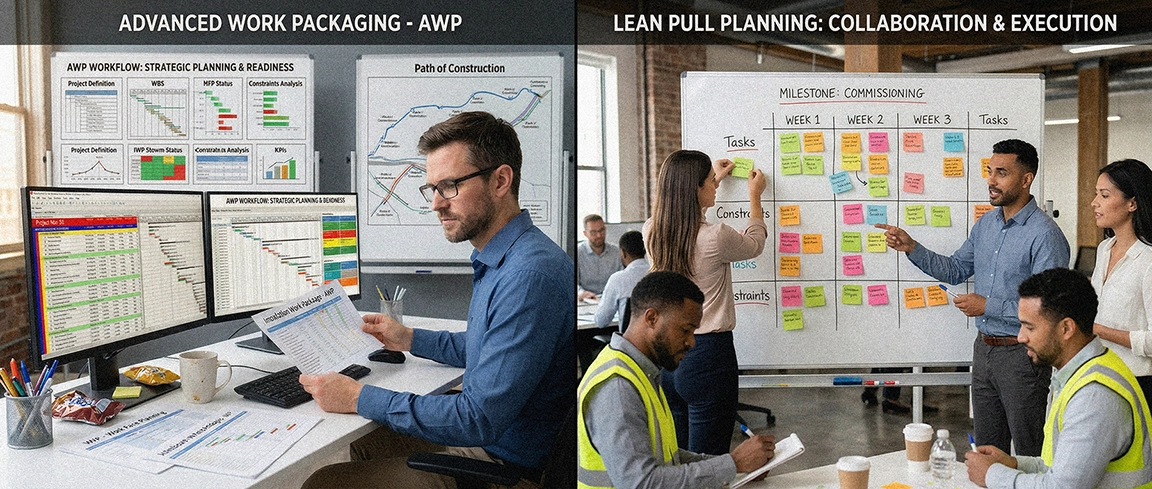
AWP and Lean Pull Planning are often grouped together, but they solve different problems.
AWP defines the structure of the work. It determines what should happen, in what sequence, and with what dependencies. It operates at a strategic level, shaping how the project is intended to unfold.
Lean Pull Planning focuses on execution. It ensures that teams are committing to work that is ready, identifying constraints, and coordinating effectively in the short term.
When combined, they create a powerful framework: a well-structured plan executed with discipline and reliability.
However, even with both in place, many projects struggle to achieve the levels of performance suggested by industry benchmarks.
The Gap Between Proven Potential and Reality
If AWP and Lean Pull Planning can deliver measurable improvements in schedule, cost, and productivity, why do so many projects still experience delays and rework?
The answer is not that the methodologies are flawed.
It is that their full value is rarely realized in practice.
On many projects, AWP exists as a well-developed plan, but it is not continuously updated to reflect changing conditions. Pull planning is implemented, but often relies on information that is incomplete or outdated. Constraints are identified, but not always tracked in a way that ensures they are resolved before impacting execution.
As a result, the project operates with a disconnect between intention and reality.
The methodologies define what should happen. The project, however, unfolds differently.
.webp)
The Role of Information Flow in Project Performance
At the heart of this disconnect is the way information flows - or fails to flow - through the project.
In most environments, planning and execution are not fully connected.
The AWP plan is typically maintained in schedules or planning tools and updated periodically. Pull planning operates in a more dynamic rhythm, with teams making short-term commitments based on their current understanding of readiness.
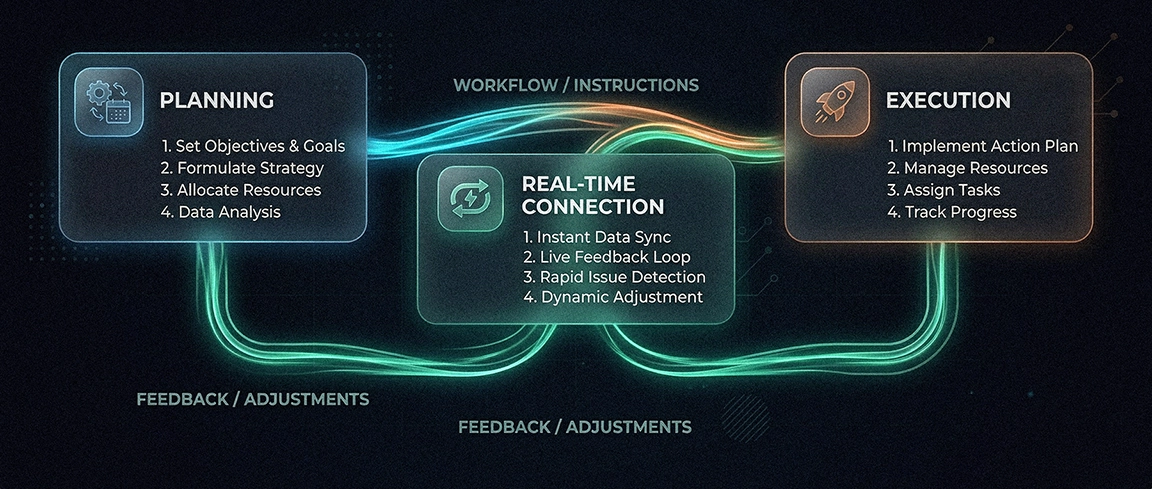
What is missing is a continuous, real-time connection between these layers.
When a deliverable changes, its downstream impact is not always immediately visible. When a constraint emerges, it may be discussed but not systematically tracked across the broader plan. When teams commit to work, they may be doing so based on information that is already out of date.
This introduces a time lag - and that time lag directly erodes the benefits these methodologies are designed to deliver.

Why Time Lag Undermines ROI
The performance improvements associated with AWP and Lean Pull Planning are not accidental. They are the result of better alignment, improved visibility, and more reliable execution.
However, these outcomes depend on one critical factor: timely, accurate information.
When projects rely on weekly updates, manual reporting, and disconnected systems, that condition is not met.
By the time an issue is identified, it may already be several days old. In complex projects, that delay is enough for its impact to spread across multiple activities and teams.
What could have been addressed early becomes a larger, more costly problem.
This is why many projects only realize a portion of the potential benefits. The methodologies are in place, but the execution environment does not support them fully.
The result is a gap between what is possible - as reflected in industry ROI benchmarks - and what is actually achieved.

From Static Frameworks to Dynamic Execution
Closing this gap does not require new methodologies.
AWP and Lean Pull Planning already provide a strong foundation.
What is needed is a shift in how they are implemented - from static processes to more dynamic, connected systems of execution.
This means ensuring that deliverables, activities, constraints, and commitments are not managed in isolation, but as part of a continuously updated and inter connected model of the project.
In such an environment, planning and execution are no longer separate. Changes are visible as they occur. Decisions are based on current information. The impact of those decisions is understood immediately.
Only then can the full value of these methodologies be realized.
.webp)
Final Thought
The capital projects industry does not lack proven approaches to planning and execution.
It has, in fact, developed a clear understanding of what drives better outcomes - supported by research and demonstrated through measurable improvements in schedule, cost, and productivity.
The challenge now is not adoption, but realization.
Until planning and execution are connected in real time, much of the value these methodologies promise - the 10–25% schedule gains, the improved reliability, the reduction in rework - will remain only partially achieved.
And projects will continue to follow a familiar pattern: well structured, well managed, and yet still falling short of their full potential.