CRM
Customers and relationships

HOW OPTIMALITY WORKS
Your organization already records customers, transactions, schedules and documents. Optimality records the operational reality between them: the activities, meetings, decisions, commitments, dependencies and changes that shape outcomes.
THE MISSING RECORD
Each enterprise system remains authoritative for what it manages. Optimality adds the connected record of execution that usually lives between applications, conversations and people.
Customers and relationships
Transactions and resources
Plans and schedules
Documents and knowledge
How work actually happens
ORIGINAL OPERATIONAL SIGNALS
These signals are created while people and agents do the work. They are not simply retrieved later from another system.
Workflow and mobile experiences record the details that shape execution, close to where the work is done.
Decisions, discussion, ownership and evidence stay connected to the work that created them.
Understand what moved, why it moved and what else could be affected.
TWO SOURCES. ONE OPERATIONAL PICTURE.
Live signals and records connected through the relationships that make them meaningful.
Optimality complements your existing systems. It does not ask them to become something they were not designed to be.
THE LIVING OPERATIONAL MODEL
Optimality maintains the relationships between operational signals. A meeting is not left as an isolated transcript. Its decisions, effects, owners and follow-through remain connected.
COMPOUNDING CONTEXT
Optimality helps your organization retain and use it. Decisions, commitments, evidence, outcomes and lessons stay connected to the work where they originated.
Over time, this creates a richer operational memory owned by the organization. Future people and agents can interpret new situations with more relevant context.
THE FUTURE OF WORK
Work is coordinated around outcomes, responsibilities and evidence, not a rigid reporting hierarchy. People and Optimizers can contribute across different schedules while shared context keeps execution coherent.
Every activity has visible ownership, status and expected evidence.
Context persists so progress does not depend on everyone being in the same room or timezone.
Optimizers work within defined permissions, review points and escalation paths.
LIVE OPERATIONAL INTELLIGENCE
Understand current work without waiting for retrospective reporting.
Identify movement across activities, commitments and dependencies.
Follow relationships and downstream consequences.
Keep decisions and knowledge attached to the work.
Focus attention on the actions, owners and evidence that matter now.
CONTEXT FOR AI
Connecting AI to enterprise systems gives it access to records. Optimality also maintains the operational relationships between those records and the signals generated as work happens.
That governed context helps people and agents interpret questions in relation to real responsibilities, dependencies, decisions and outcomes.
CRM + ERP + P6 + Documents
More records to searchLive signals + relationships + history
Work that can be understood in contextTHE OPTIMALITY PLATFORM
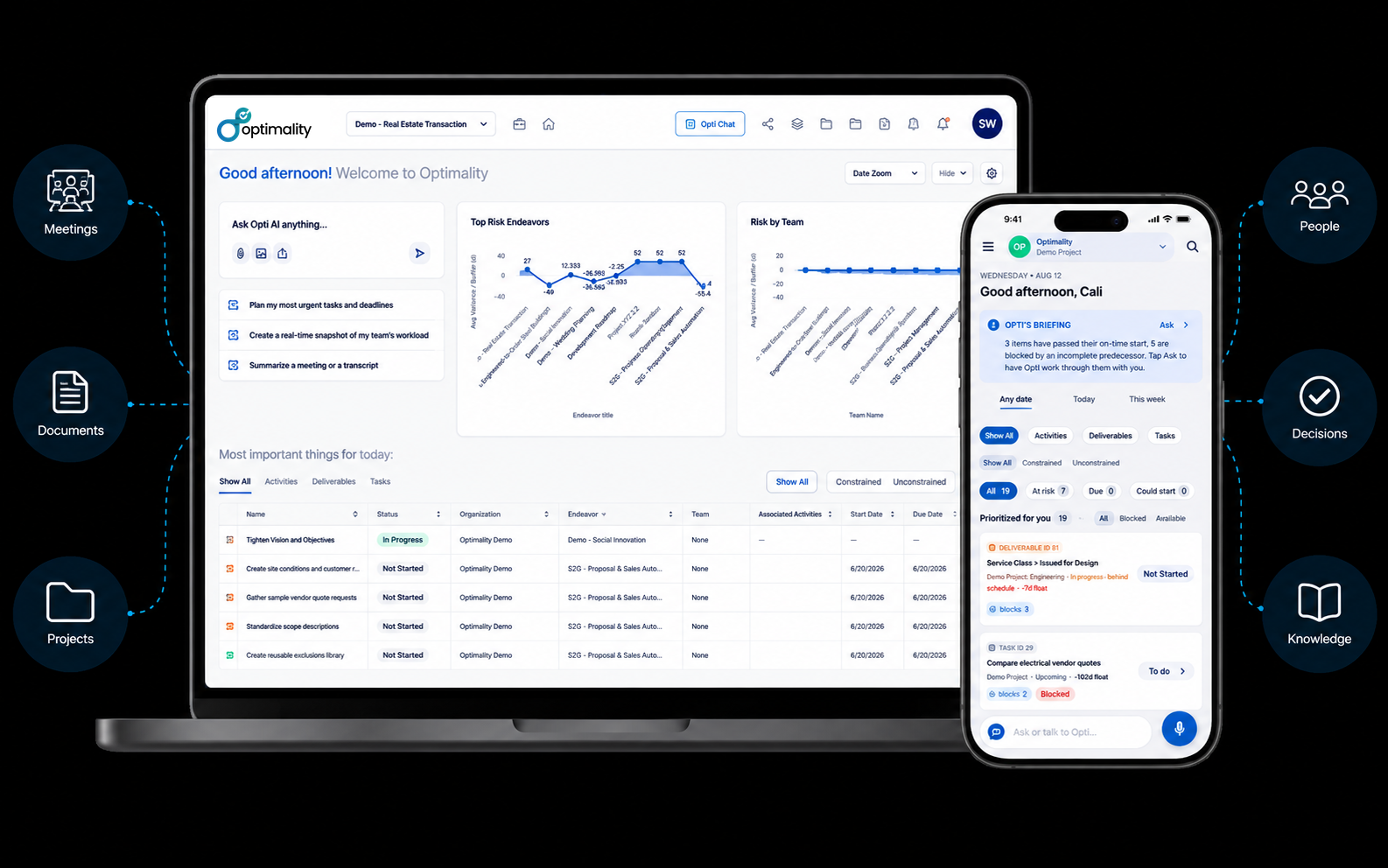
Optimality brings the operational picture into practical desktop and mobile experiences, so teams can structure work, capture signals and stay connected wherever execution happens.
A CAPITAL PROJECT EXAMPLE
The formal date matters. The operating picture around it matters too.
An unresolved commitment still has no confirmed evidence.
A decision from yesterday's meeting changes the work sequence.
A predecessor activity is slipping and another team owns the dependency.
Field status has changed since the last schedule update.
QUESTIONS, ANSWERED
Optimality is the system of record for how work actually happens. It connects activities, decisions, commitments, dependencies, people, evidence and change into a living operational model.
No. Those systems remain authoritative for the records they manage. Optimality adds the operational context between them and the signals created through everyday work.
It is a connected representation of work as it changes. It preserves relationships between activities, people, decisions, commitments, dependencies, evidence and outcomes.
Optimality connects operational context across work, systems, people and agents. It can support projects, but its model is broader than task tracking or a single workflow.
That provides access to records. Optimality also captures original live signals and maintains the operational relationships that help people and agents interpret those records in context.
People and Optimizers work in the same execution network with defined responsibilities, permissions, evidence requirements, review points and escalation paths.
THE CONNECTED RECORD OF EXECUTION
Know what's happening. Know what to do next.