

TL;DR
AI agents may make enterprise systems of record more valuable while making their applications less central to how people experience work. As agents become capable of operating CRM, ERP, scheduling, document and collaboration systems for us, the organizing principle of enterprise software could shift from the application to the outcome.
The future enterprise may be less about people navigating software and more about people and agents working from a shared understanding of what needs to be accomplished. The systems will remain underneath, providing authority and control. The work will move above them.
Written by Dr. Simon Wright, CEO of Optimality.
The application may no longer be the natural starting point
A recent article by Seema Amble at a16z made a persuasive case that AI could strengthen incumbent systems of record. Her phrase, “the job is bigger than the record,” stayed with me.
The argument is that agents need reliable data, permissions and ways to take action. Salesforce still owns the customer record. An ERP still controls important transactions. A scheduling system still holds the approved plan. If agents can use those systems on our behalf, their data and controls become more valuable, not less.
I think that is probably right. But it raises a more interesting question.
If agents can increasingly operate the applications, why should people continue organizing their work around them?
For more than thirty years, enterprise software has trained us to think about work in terms of where information lives. Sales goes to the CRM. Finance goes to the ERP. Planning goes to the scheduling system. Documents live in another application. Decisions are scattered across meetings, email and messaging tools.
This structure made sense when the application was both the keeper of the record and the only practical way to interact with it. If you wanted to understand the customer, you opened the CRM. If you wanted to change the schedule, you opened the scheduling application. The interface and the record were effectively one thing.
That coupling is beginning to loosen. Salesforce and Anthropic are already presenting Claude as a place where a seller can reason over Salesforce information and take governed action without beginning inside the Salesforce interface. It is an early example, but the direction is significant: the system can retain the record, rules and permissions while another layer becomes the front door to the work.
Once that separation becomes normal, the application is no longer the obvious place to begin.
Think about how people actually describe their jobs. A construction manager does not wake up thinking, “Today I need to interact with six enterprise applications.” They think, “We need to get this work package ready by Friday.”
A salesperson thinks about winning an account. An engineer thinks about resolving a design problem. An executive thinks about whether an important initiative will deliver the intended result. The application comes afterwards because it contains information or capability needed to do the job.
We designed enterprise technology in the opposite direction. We started with the application, defined the records it would own and built workflows within its boundaries. People then became responsible for carrying the context between those boundaries.
AI agents could reverse that relationship.

No single application owns “ready”
Consider the apparently simple question of whether a construction work package is ready to start.
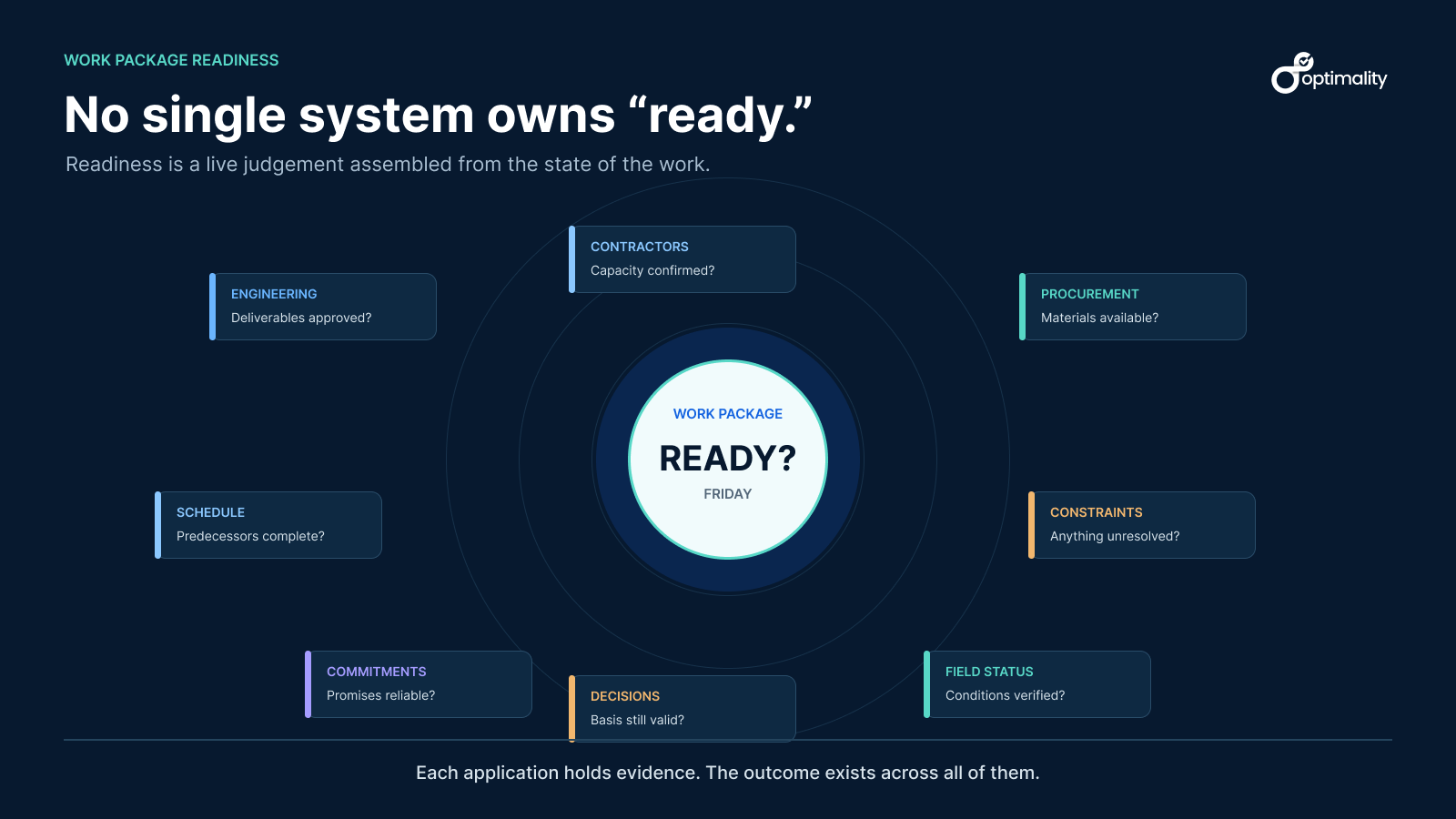
The schedule may show that predecessor activities are complete. Engineering may have issued the required deliverables. Procurement may report that the materials are available. A planning tool may contain open constraints. A contractor may have made a commitment based on yesterday’s information. A decision in this morning’s coordination meeting may have changed the basis of the plan. Conditions in the field may no longer match what anyone expected.
Each system holds part of the evidence. None owns the outcome.
“Ready” exists in the relationships between the engineering, materials, schedule, constraints, commitments, contractors, decisions and actual field conditions. It is a live judgement about the state of the work.
Today, experienced people assemble that judgement. A good project manager knows which drawing affects which activity, what procurement has already ordered, who promised to resolve the constraint and which conversation changed the plan. Much of this operating model lives in people’s heads and is continually reconstructed through meetings, spreadsheets and follow-up messages.
Agents could take on a meaningful part of that coordination. But the most useful instruction would not be a sequence of application commands:
“Open the schedule, find these activities, check the document repository, compare the latest revision and then look in procurement.”
It would be:
“Are we going to be ready to start this work next Friday?”
That question begins with the outcome. The technology works out which systems, people and other agents need to participate in answering it.
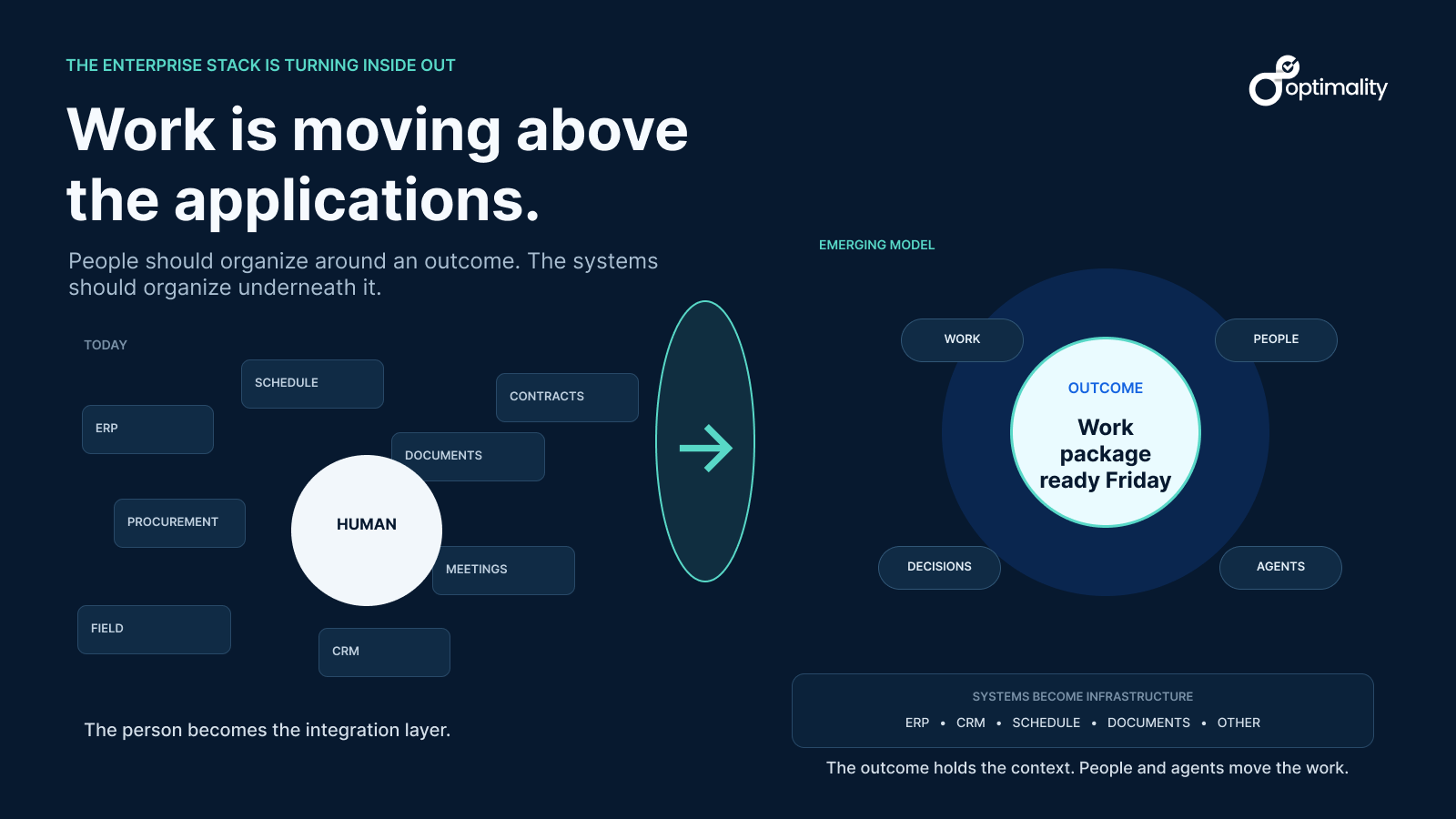
The enterprise stack turns inside out
The model we have inherited largely runs in this direction:
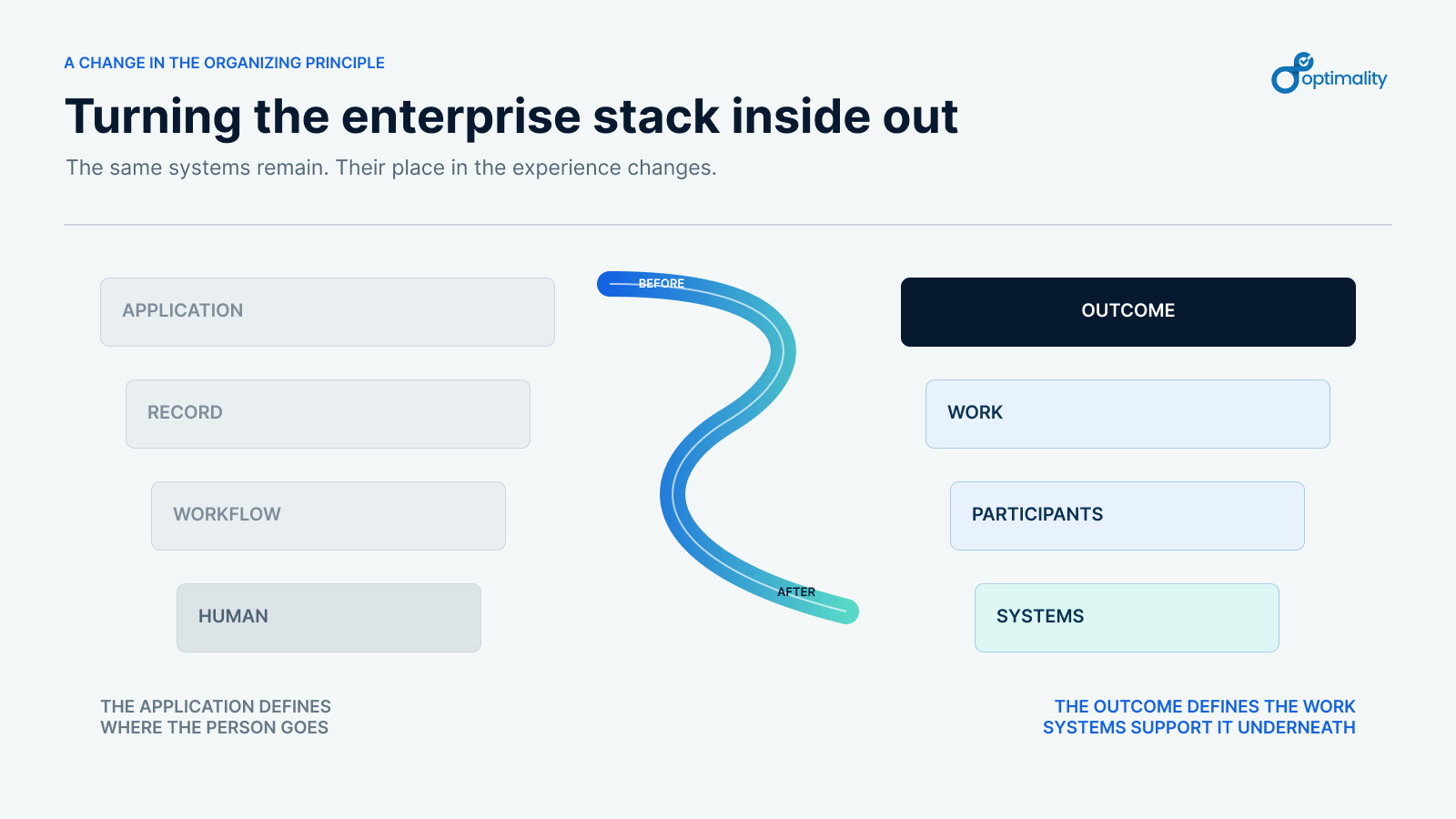
Application → Record → Workflow → Human
The application defines the boundary. Its records define what can be seen. Its workflow defines what happens next. The person receives the task and fills in whatever context the system cannot provide.
The emerging model could run in the other direction:
Outcome → Work → Participants → Systems
The outcome establishes what matters. The work is assembled around it. Participants join according to what they know or can do, whether they are employees, contractors or agents. The underlying systems provide trusted data, specialist capabilities, permissions and controlled actions.
The systems do not disappear. They become infrastructure for the outcome.
That is a deeper change than adding an AI assistant to every application. It changes what the organization presents to the person as the work itself.
Instead of opening five dashboards and trying to infer what deserves attention, a leader could begin with the outcomes for which they are responsible. Instead of receiving another task stripped of its wider purpose, someone could see the decision, evidence and dependencies surrounding it. Instead of generating a summary and leaving a person to translate it into action, an agent could help move the outcome forward within explicit boundaries.
The interface becomes less about navigating software and more about understanding intent, state and consequence.
More agents could create faster silos
There is an uncomfortable possibility in the current rush toward enterprise agents. We may automate the applications without changing the operating model.
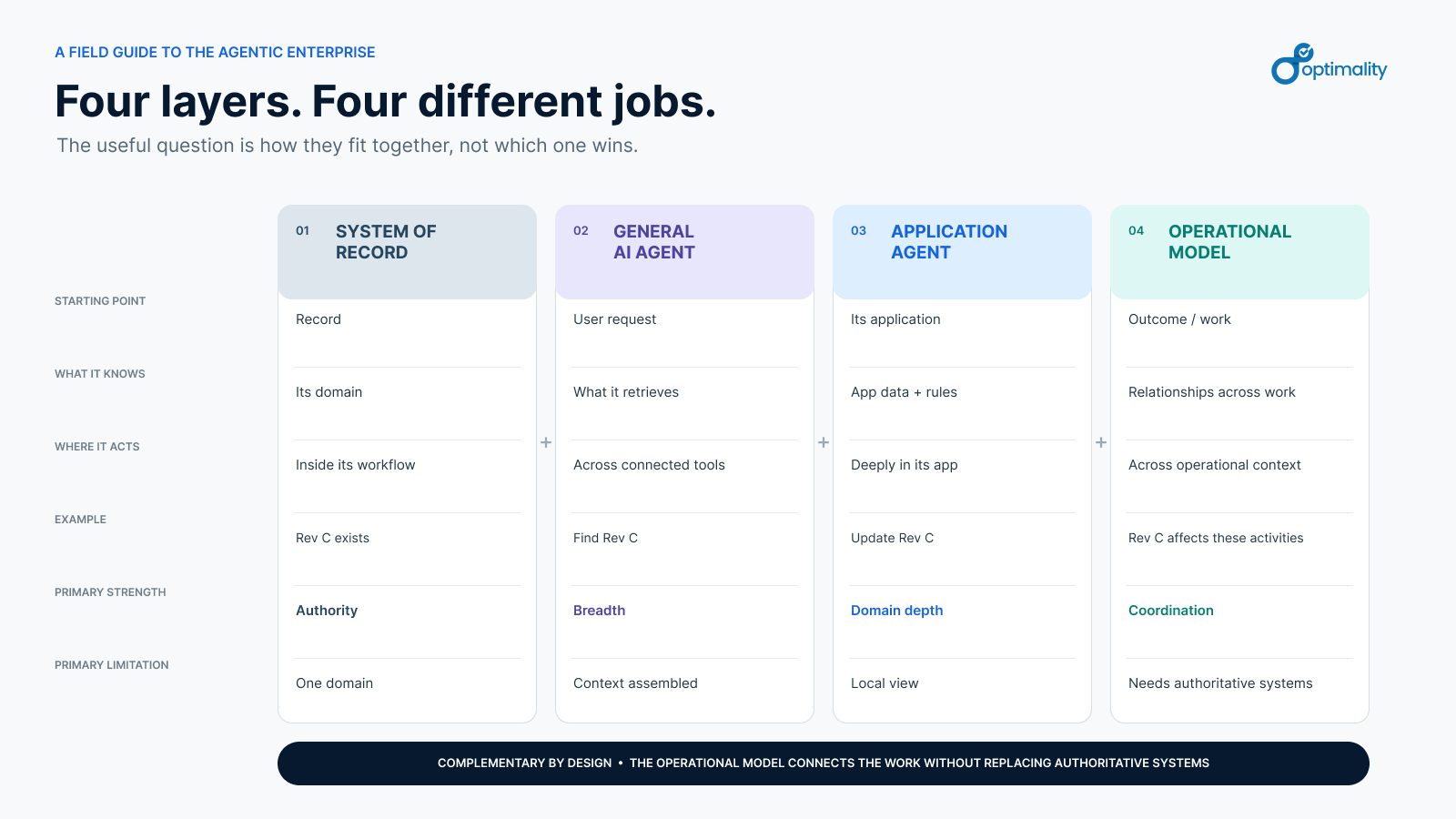
The CRM will have agents. The ERP will have agents. Scheduling, procurement, document control and collaboration platforms will have agents. Companies will build their own specialist agents, and employees will bring general-purpose agents capable of working across several tools.
This could create enormous productivity. It could also reproduce the fragmentation we already have at much greater speed.
A procurement agent can optimize procurement. A scheduling agent can protect the schedule. An engineering agent can accelerate engineering. Each may perform brilliantly within its own frame while the overall outcome deteriorates.
Organizations already know this problem. Local optimization is not organizational performance. Giving every silo an intelligent agent does not create a shared understanding of the work.
The agentic enterprise will therefore need more than access and orchestration. It will need a common operational model that allows participants to understand how their actions affect the result beyond their own system.
Memory will not be enough
It is tempting to think that a sufficiently capable general agent, connected to every application and equipped with long-term memory, will assemble this understanding when required.
That may work for simpler jobs. It becomes less convincing as the work grows more consequential, distributed and long-running.
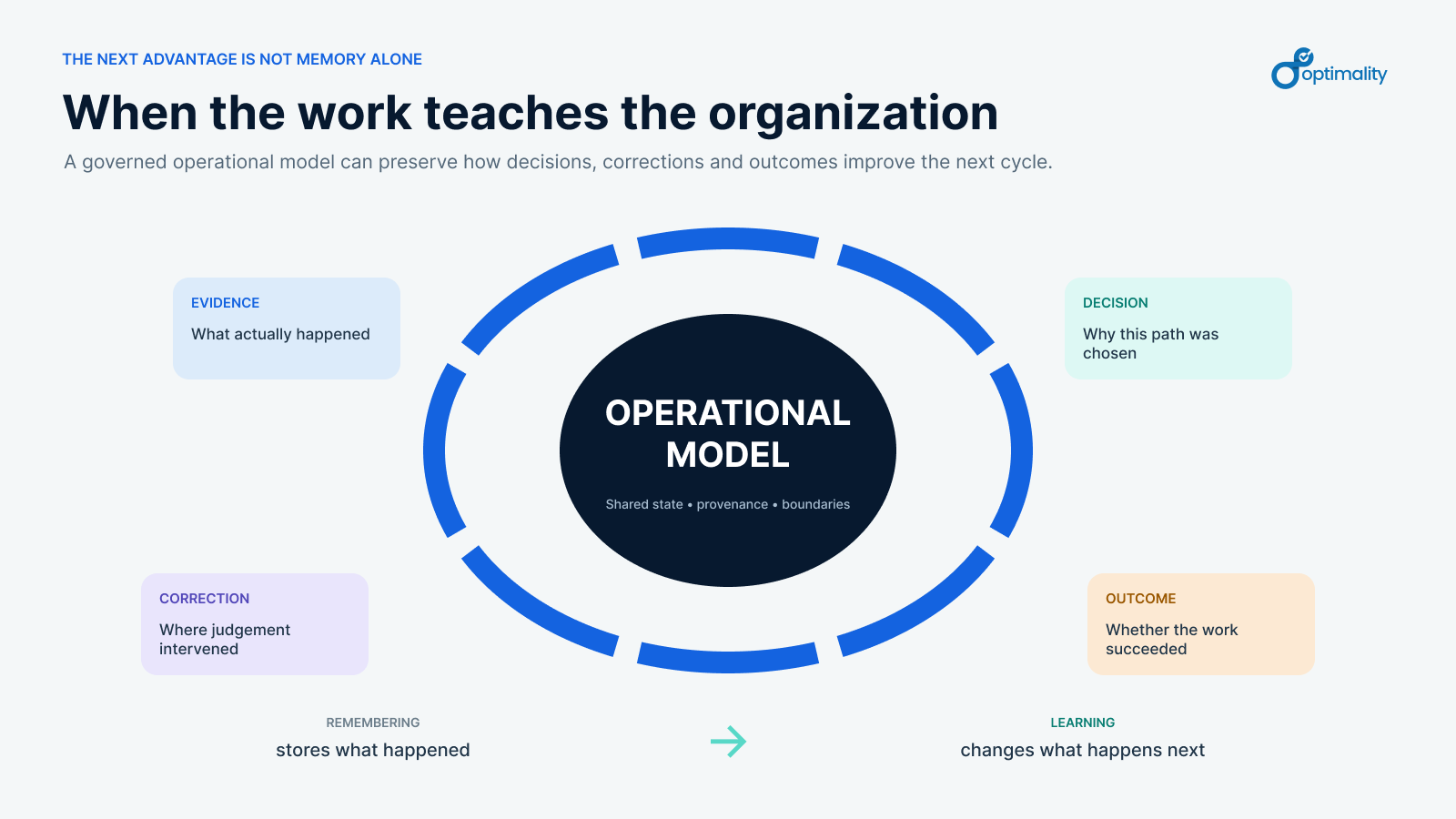
Access tells an agent where to retrieve information. Memory helps it recall what happened. Neither automatically tells it how the organization’s work fits together, which source is authoritative, why an exception was accepted or whether the eventual outcome was good.
The more important capability will be learning through the work.
Imagine an operational model that does more than remember that a work package was released. It retains which constraints were considered, what evidence supported the decision, where an expert corrected the recommendation, which commitment proved unreliable and what happened in the field afterwards. Over many cycles, the organization begins to learn what “ready” actually means in its own environment.
That learning should not mean quietly training a black box on everything employees do. It should be governed and inspectable. People should be able to see where a recommendation came from, which records support it, what an agent changed, who approved it and what happened as a result.
This will also change human oversight. As agents become more capable, people are unlikely to approve every small action forever. They will supervise goals, boundaries, exceptions and results. That makes the operational model even more important because oversight depends on seeing the state of the work and the reasoning behind movement, not merely reviewing an endless queue of agent transactions.
The future interface may be a living model of the work
I do not think conventional enterprise interfaces will vanish. Specialists will still need detailed controls. Finance teams will inspect transactions. Planners will work directly with schedules. Engineers will need purpose-built environments.
But those interfaces may stop being the primary place where the wider organization experiences work.
The more natural interface could be a living model of the outcome: what we are trying to achieve, what has to be true, what has changed, who or what is involved, where judgement is required and what should happen next.
Sometimes that interface will be conversational. Sometimes it will be visual. Sometimes an agent will operate in the background and surface only an exception. The important point is that the interface is shaped by the work rather than by the boundaries of the underlying application.
Over time, even the commercial logic of enterprise software could change. When people spend less time inside applications, seat count and screen engagement become weaker measures of value. Customers may care more about completed processes, avoided delays, reliable decisions and outcomes achieved. Software will increasingly have to earn its place by helping finish the work, not by keeping users inside the product.
This is changing how I think about Optimality
We came to this question through complex project delivery, not through an abstract theory about the future of SaaS.
Projects make the coordination problem impossible to ignore. Activities, documents, decisions, constraints, commitments, knowledge and people constantly affect one another. Established systems record many of those elements well, yet the understanding of how they fit together is still carried by experienced individuals.
Optimality is being built as an operational coordination platform across that environment. It does not need to become the ERP, CRM, document repository or scheduling system. Those systems can continue performing the specialist jobs they do well.
The opportunity is to model the work that crosses them: the relationships, changing state, decisions, commitments and accumulated learning involved in getting an outcome accomplished. Humans and agents can then participate through the same shared operational context, with the underlying systems retaining their authority.
That feels much larger than improving how someone navigates enterprise software. It points toward a different way of structuring the enterprise itself.
The organizations that move furthest in this direction may eventually stop designing work around functions and applications. They may form dynamic teams of people and agents around outcomes, drawing on systems and specialist capabilities as required. The operating model becomes less rigid, but the context around the work becomes more explicit.
The enterprise technology question of the next few years may therefore be larger than which AI assistant employees should use or which incumbent adds the best agent.
It may be whether people need to organize their work around applications at all.
If agents can operate the software, perhaps people can finally concentrate on the work. And perhaps enterprise software can finally be organized around the same thing.
Explore outcome-centered coordination
Optimality connects work, decisions, commitments, deliverables, people and knowledge in a shared operational context that complements existing enterprise systems. You can explore the platform and start a free 14-day trial at optimalitypro.com.
Frequently asked questions
Will AI agents replace enterprise systems of record?
Probably not. ERP, CRM, scheduling, document management and similar systems provide authoritative records, specialist business rules, permissions and auditability. Agents are more likely to change how people interact with those systems and coordinate work across them.
What is outcome-centric enterprise software?
Outcome-centric enterprise software begins with a result the organization is trying to achieve. It assembles the relevant work, participants, decisions and supporting systems around that outcome instead of requiring people to navigate applications separately and combine the context themselves.
Why is access to enterprise applications insufficient for an AI agent?
Access allows an agent to retrieve information and take permitted actions. It does not automatically provide a persistent understanding of how activities, documents, decisions, commitments, people and dependencies relate to the outcome, or which information is authoritative.
What is an operational model?
An operational model is a living representation of how work fits together and changes over time. It connects activities, participants, deliverables, decisions, constraints, commitments, knowledge and outcomes so that people and agents can understand what is happening and what their actions may affect.
Does an operational coordination platform replace ERP, CRM or project controls software?
No. It provides context across those systems while allowing them to remain authoritative within their specialist domains. Its role is to coordinate the work that crosses their boundaries.