

TL;DR
ChatGPT, Claude and Gemini are rapidly becoming capable of connecting to enterprise systems, retrieving company knowledge and using tools to act across workflows. That raises an uncomfortable question for every enterprise software company: if general-purpose AI can understand the business directly, why do we still need another application?
The answer is unlikely to be better AI, or even better access to context. Both are becoming easier to obtain. The enduring value will come from systems that maintain authoritative operational state, encode how work actually operates and provide governed specialist capabilities that people and AI can reliably act on. AI may not eliminate enterprise software, but it will force us to be much clearer about what enterprise software is actually for.

An Uncomfortable Question for Enterprise Software
There is a question I think every enterprise software company should be asking itself: if ChatGPT can eventually understand everything happening inside my company, why do I need your software?
A few years ago, that would have sounded provocative. Today, it is becoming a reasonable question for an enterprise buyer to ask. OpenAI’s Company Knowledge can search connected business applications and return organization-specific answers with citations. Claude can connect to remote MCP servers and use connected tools and data. Gemini Enterprise combines permissions-aware enterprise search, connectors and custom agents, while Google is developing a private knowledge graph that links people, content and interactions.
This matters because one of the strongest arguments for a new generation of enterprise software has been context. We have spent years explaining that AI cannot be genuinely useful inside a business unless it understands the organization’s people, information, processes and history. That argument remains true. The problem is that OpenAI, Anthropic, Google and every major enterprise technology company understand it too.
Context will remain essential. It is simply unlikely to remain a moat.

What Happens When Context Becomes Cheap?
Imagine a large capital-project organization running Primavera P6, SAP, SharePoint, Teams, email and several specialist engineering systems. The reality of the project is fragmented across all of them. The schedule tells one part of the story. Engineering systems contain another. Important decisions may be buried in meeting transcripts, while commercial commitments live somewhere else entirely.
An executive asks a seemingly simple question: Why is mechanical completion likely to slip? Historically, answering it could require project controls, engineering and construction teams to assemble reports, compare evidence and meet to interpret what it means. Increasingly, an AI system can search across the underlying sources, connect the relevant evidence and produce a useful answer in seconds.
That is an extraordinary improvement. It also leads naturally to another question: why not simply put ChatGPT, Claude or Gemini over the systems we already have?
For some organizations, that will be exactly the right answer. Enterprise software companies need to acknowledge that rather than pretending the threat does not exist. If an application’s primary value is aggregating information from other systems, presenting it through dashboards or providing another interface for finding information, general-purpose AI will put significant pressure on that value proposition.
The interface matters less when AI can become the interface. Access to an advanced model is not a moat when competitors can use comparable models. Even the ability to construct a knowledge or context graph is becoming less distinctive as the major AI platforms build those capabilities directly.
So what remains?
Understanding the Business Is Not the Same as Operating It
The important distinction is between understanding information about a business and maintaining the operational state of that business.
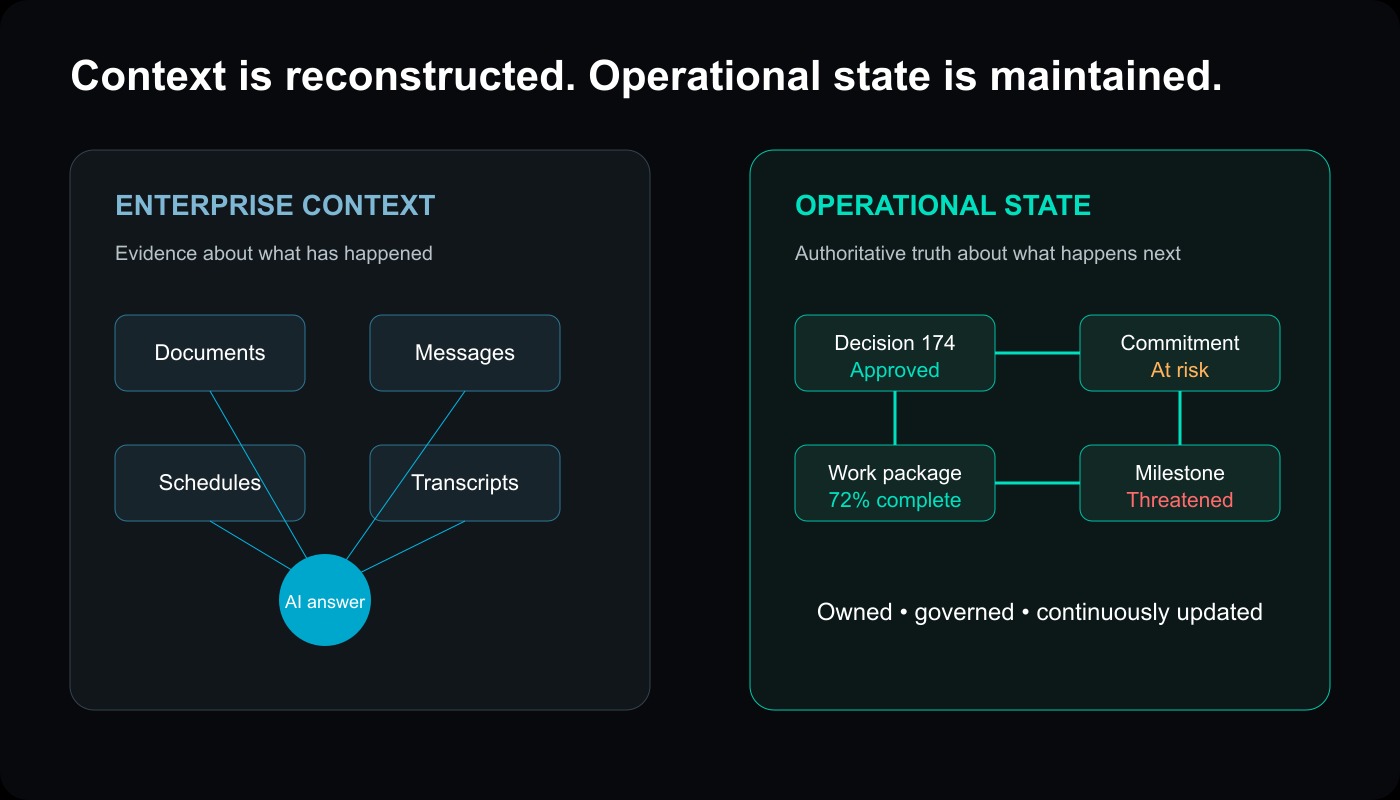
Consider what happens when a design decision changes a deliverable on a major project. That deliverable affects an engineering activity, which affects a work package. The work package has commitments associated with it, and one of those commitments may now be at risk. That risk affects construction activities and ultimately threatens a milestone.
A sufficiently capable AI model may discover many of those relationships by searching the organization’s information. It can read the schedule, examine documents, review meeting transcripts and reconstruct a remarkably good picture of what has happened. But there is a difference between reconstructing reality from evidence and maintaining a structured representation of reality as it changes.
Context tells us what people have said, written, stored and discussed. Operational state tells us what is happening now: what changed, who owns it, what depends on it, which decision was made, which commitment remains outstanding, what is blocked, what has been approved and what needs to happen next.
As AI agents become capable of taking action rather than simply making recommendations, that distinction becomes more important. An agent needs to know not only what information exists, but what is authoritative, what it is permitted to change and what downstream consequences that change creates. That is not simply a search problem. It is an operating problem.
HubSpot Offers an Interesting Clue
CRM is a useful analogy because there is less and less preventing an organization from assembling customer information from email, calendars, websites, call transcripts, spreadsheets and financial systems, then asking an AI model to determine what is happening with an account.
Yet CRM is not disappearing. HubSpot is moving in almost the opposite direction. In May 2026 it described its direction as an “agentic customer platform”: software that captures customer data and business context in one place, then makes both available to teams and AI agents. Its architecture explicitly combines a context layer, an action layer and a coordination layer with permissions, audit trails and governance.
That offers an important clue about where enterprise software may be heading. AI does not necessarily make a system of record less valuable. In some circumstances, it makes the quality of that system more important.
If an agent is going to qualify a lead, update a customer record, change a project commitment, initiate a workflow or recommend an operational decision, the organization needs to know what information is authoritative. It needs permissions, rules and governance. It needs to understand what changed and why. Once an action is taken, the outcome must become part of the organizational record so that the next person or agent operates from the new reality.
Without that foundation, we risk building increasingly intelligent agents on top of increasingly fragmented operational environments.
AI Will Still Destroy a Lot of Traditional Software Value
None of this means incumbent enterprise software is safe. I think the opposite is true.
AI creates an enormous threat to applications whose primary value is presenting information through a proprietary interface. If an agent can access the underlying data directly, why navigate six screens to find it? If AI can generate the report on demand, why spend hours configuring dashboards? If an agent can initiate the workflow directly, why should the user care which menu contains the command?
This will also put pressure on software that exists primarily to connect information from other applications. The ability to retrieve, synthesize and reason across multiple enterprise systems is moving rapidly into the AI platforms themselves.
The more useful question for any software company is therefore not, “How do we add AI?” It is: What does our system know, maintain or enable that a powerful AI cannot simply reconstruct from somewhere else?
For some applications, there may not be a good answer. Those products have a serious strategic problem. Systems that maintain an authoritative representation of something an organization needs in order to operate—customers, money, physical assets, engineering configurations, operational work or execution state—are in a different position. AI can make those systems easier to use while making their structured data and operational capabilities more valuable.
Enterprise Software Has to Become Operational Infrastructure
This points toward a different generation of enterprise software. The valuable systems will not simply store information and give humans an interface through which to retrieve it. They will maintain an authoritative model of an important part of the business, capture changes to that model as work happens and provide governed capabilities that both people and agents can execute against.
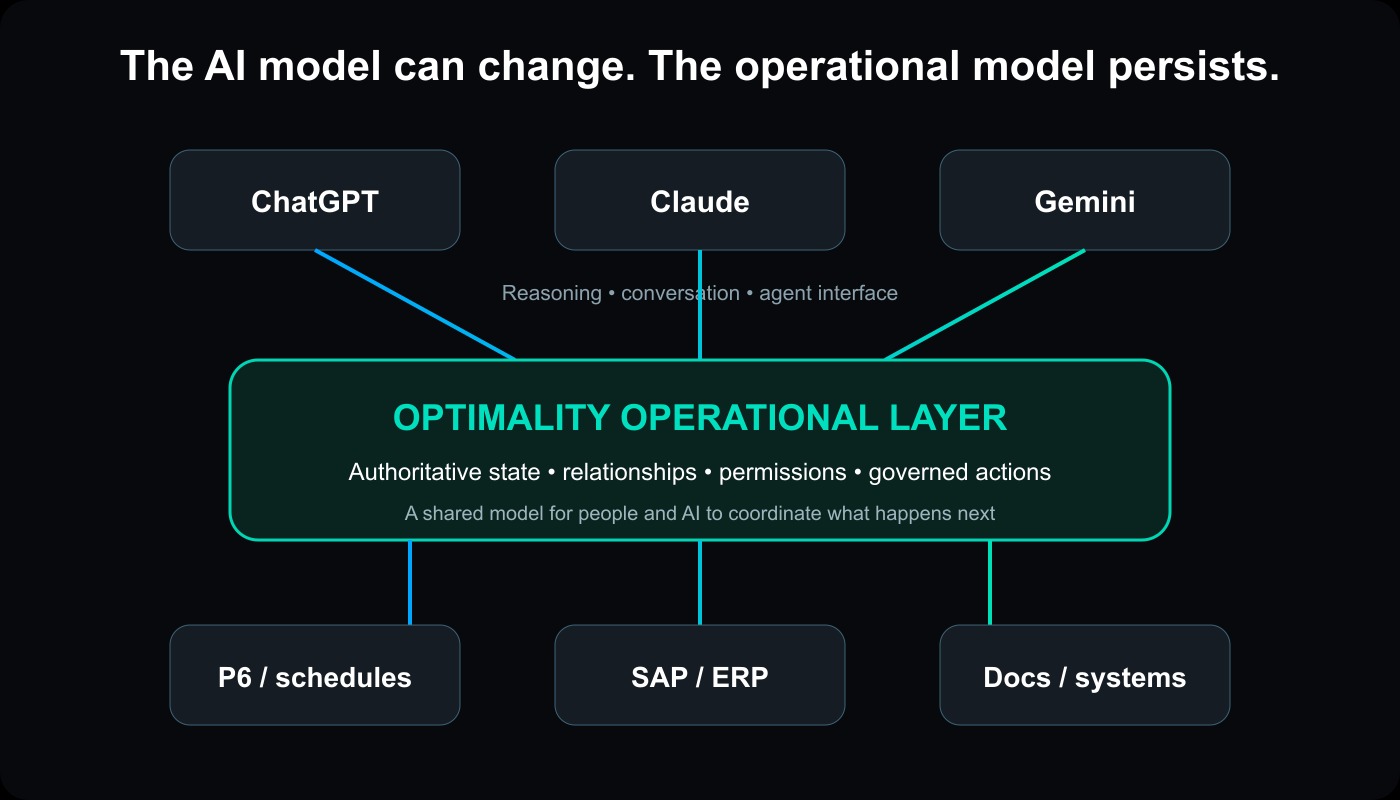
The model sitting above that system may change. Today an organization may prefer GPT. Tomorrow another model may outperform it. One company may standardize on Claude while another chooses Gemini because it fits more naturally with its technology environment. That should be treated as a feature of the architecture rather than a threat to it.
The AI model should be interchangeable. The operational model should not be.
The future architecture of enterprise AI may therefore look less like one giant AI replacing every business application and more like AI becoming a universal interface across a new generation of specialized operational platforms. The AI provides increasingly powerful reasoning. The operational platform provides the state, structure, rules and capabilities required to turn that reasoning into reliable action.
The Marketplace Changes the Economics Again
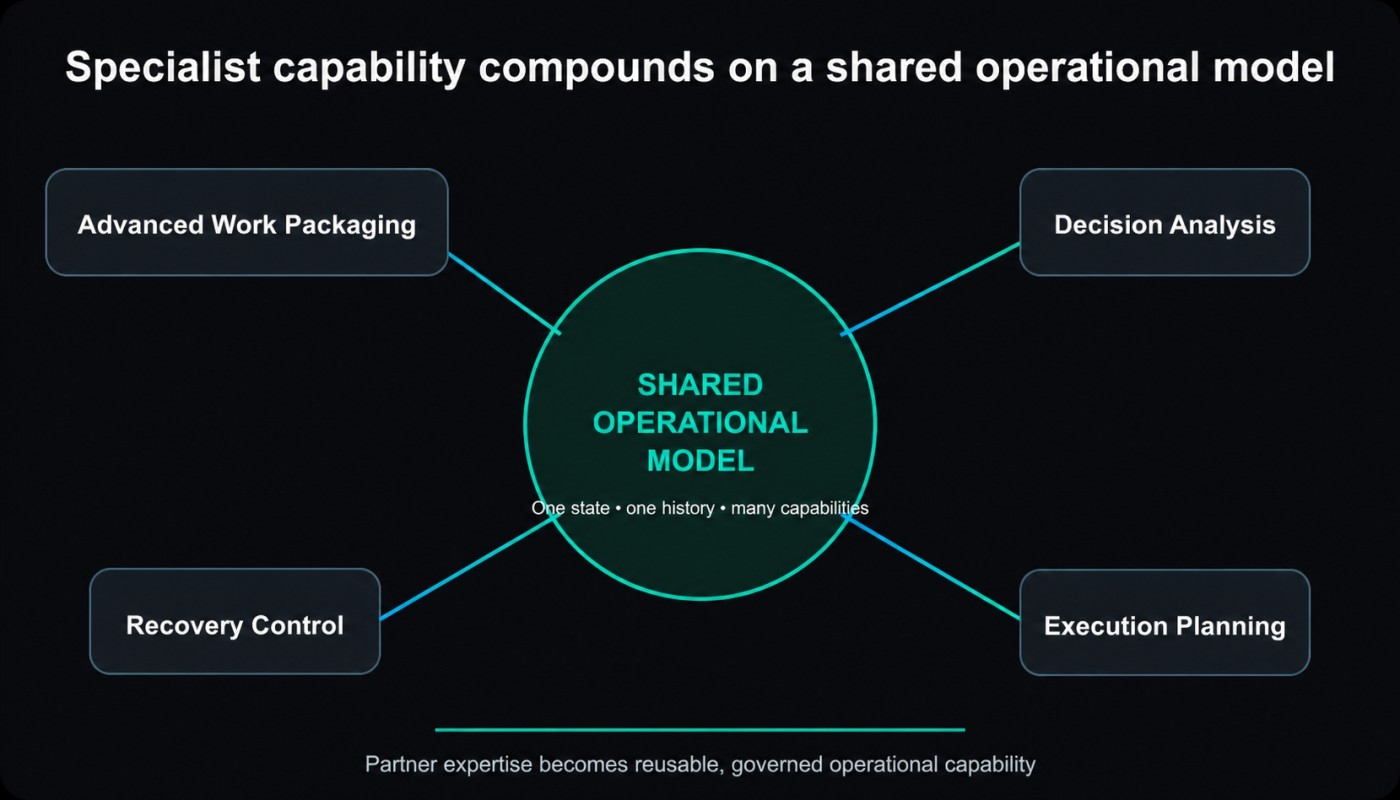
Once an underlying platform maintains operational state, specialist capabilities can operate against that shared model. In capital projects, one specialist may have deep expertise in Advanced Work Packaging. Another may specialize in decision analysis. Another may have spent decades recovering projects that have fallen behind schedule. Others may specialize in estimating, commissioning, constructability or execution planning.
Historically, much of that expertise has been delivered through consulting engagements, proprietary methodologies, spreadsheets and individual experience. It may create enormous value during an engagement but remain difficult to scale, reuse or embed permanently into the customer’s operating environment.
An operational platform creates the possibility of turning some of that intellectual capital into reusable software capabilities. A decision-analysis capability can create a decision that becomes part of the operational record. That decision may affect deliverables and activities. A planning capability can understand the resulting impact. A recovery capability can detect an emerging execution risk. An AI agent can help coordinate the response, while the outcome becomes part of the same operational history.
Each specialist capability becomes more useful because it operates against a shared operational model. The platform becomes more useful because every additional capability expands what organizations can accomplish through it. That starts to look less like a traditional software product and more like an operational ecosystem.
Where Optimality Fits
This is one of the questions we have been wrestling with at Optimality, because the evolution of general-purpose AI affects our strategy just as much as anyone else’s.
It would be easy to argue that our advantage comes from connecting work, knowledge, decisions and people so AI has better context. I do not think that argument goes far enough anymore. ChatGPT, Claude and Gemini will become exceptionally good at finding and constructing context across enterprise systems, and trying to compete with them on general intelligence would make little sense.
The opportunity we see is different. Optimality is being developed as an Operational Coordination Platform: an environment where work, knowledge, decisions, commitments, people and AI are connected within a shared operational model. The objective is not simply to help AI understand what is happening. It is to maintain the operational state against which people and AI can coordinate what happens next.
Optimality should not require a customer to choose our AI instead of theirs. If an organization prefers ChatGPT, Optimality should work with it. If another enterprise standardizes on Claude or Gemini, the operational environment underneath should not lose its value. General-purpose AI can increasingly become the interface and reasoning layer. Optimality provides the operational structure, execution state and governed capabilities underneath it.
The marketplace adds another dimension. Partners with specialist methodologies and deep domain expertise can potentially turn that intellectual capital into reusable operational capabilities that run against the same underlying model. Instead of every enterprise rebuilding Advanced Work Packaging, decision analysis, project recovery or other specialist capabilities through its own collection of agents and prompts, those approaches can become deployable capabilities within the operating environment.
That is a very different proposition from putting another chatbot on enterprise data.
The Question Every Software Company Should Ask
There is a simple thought experiment every enterprise software leadership team should run. Imagine ChatGPT, Claude and Gemini become dramatically better over the next three years. They can access every enterprise system the customer permits, understand enormous amounts of organizational context, construct sophisticated knowledge graphs, create reliable agents and execute workflows across applications.
What remains valuable about your product?
If the answer is the interface, there may be a problem. If the answer is access to AI, there is almost certainly a problem. If the answer is that your application aggregates information from other systems, that advantage may also be disappearing faster than many companies expect.
But if your software maintains an authoritative representation of something the organization needs in order to operate, the conclusion may be different. As AI takes on more consequential work, the need for reliable operational state, governance, provenance and specialist domain capabilities does not disappear. It may become substantially more important.
The biggest winners in enterprise software will not necessarily be the companies that build the smartest AI. The frontier model companies already have an enormous advantage in that race. The larger opportunity may belong to the companies that give increasingly intelligent AI the best environment in which to work.
For enterprise leaders, that is the more useful way to think about the next wave of AI investment. Do not just ask how intelligent the AI is. Ask what it is operating on.
Frequently Asked Questions
Will ChatGPT, Claude or Gemini replace enterprise software?
They are likely to replace some functions currently performed through enterprise software, particularly information retrieval, reporting, basic analysis and navigation. Systems that maintain authoritative business records, operational state, permissions, workflows and specialist capabilities are more likely to remain important. AI may increasingly become the interface to those systems rather than replacing all of them.
What is the difference between enterprise AI context and operational state?
Enterprise AI context helps a model find and understand relevant information across an organization. Operational state is the authoritative, current representation of a business process, including relationships, ownership, status, decisions, dependencies, permissions and changes.
Operational State and Systems of Record
Can an AI platform build its own knowledge or context graph?
Yes. Google already provides private Knowledge Graph capabilities within Gemini Enterprise, and all major AI platforms are improving their ability to connect and reason across enterprise information. A context graph alone is therefore unlikely to provide sustainable differentiation. The greater opportunity is maintaining domain-specific operational state and capabilities that people and AI can reliably act upon.
Why would a company not build its own operational system using AI agents?
Some will. Organizations with strong engineering teams, specialized requirements and sufficient resources may decide that building their own architecture is the right approach. The trade-off is that they must define the domain model, integrations, permissions, workflows, governance and ongoing maintenance themselves. Productized operational platforms can make sense where the capability is complex, reusable and expensive to recreate.
Does AI make systems of record less important?
Potentially the opposite. As AI agents perform more consequential work, organizations need reliable information about what is true, what changed, who authorized an action and what happened as a result. The importance of authoritative operational data may increase as AI becomes more autonomous.
Architecture, Optimality and AI
What is an Operational Coordination Platform?
An Operational Coordination Platform connects work, knowledge, decisions, people, commitments and execution within a shared operational model. Rather than simply storing information, it maintains the relationships and state required to coordinate complex work across people, systems and AI.
How is this different from project management software?
Traditional project management software generally focuses on schedules, tasks, resources or reporting. Operational coordination is broader: it connects the work being performed with the decisions, knowledge, deliverables, dependencies and commitments surrounding that work. The objective is to understand not only what is scheduled but how changes and decisions propagate through execution.
Will companies have to choose between Optimality and ChatGPT, Claude or Gemini?
They should not have to. A stronger long-term architecture is model-agnostic. General AI platforms can provide reasoning and conversational interfaces, while operational platforms provide authoritative state, domain capabilities and governed actions. The two layers can complement each other.
What Executives Should Ask
Why do marketplaces matter in this model?
A marketplace allows specialist expertise to become reusable operational capability. Instead of every organization rebuilding methodologies such as decision analysis, Advanced Work Packaging or project recovery independently, specialist providers can package those approaches as modules that operate against a shared operational model.
What should executives ask when evaluating AI-era enterprise software?
Ask: If general-purpose AI becomes dramatically better and can access all our existing systems, what unique value does this software still provide? The strongest answers will increasingly involve authoritative data, operational state, domain expertise, governance, execution capability and measurable business outcomes—not simply access to AI.