

TL;DR
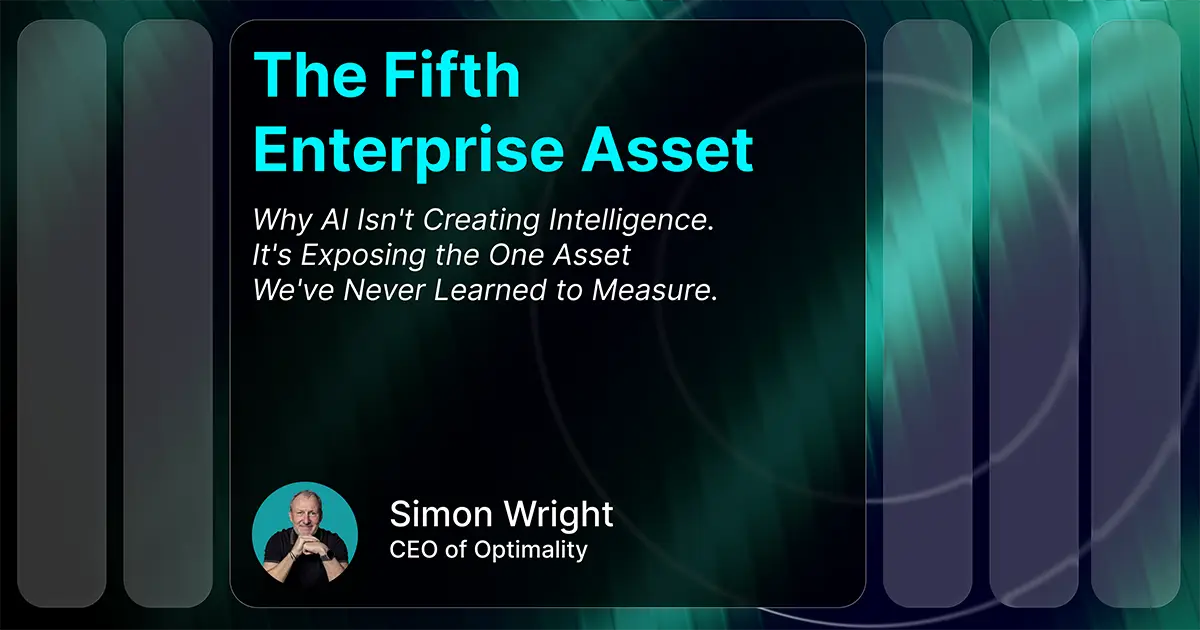
We've spent decades managing businesses around four assets: financial capital, physical assets, human capital and intellectual property. I believe there's a fifth asset that has always determined which companies outperform, but we've never had a way to see or measure it. I call it operational capability—an organization's ability to consistently coordinate people, decisions, systems, knowledge and now AI to execute better than its competitors. AI isn't creating this capability. It's simply making visible something that has always been there.

The Question We've Been Asking Wrong
For most of my career, I've watched organizations invest enormous amounts of money trying to become better businesses.
They buy new ERP systems. They modernize their engineering platforms. They implement collaboration tools, document management systems, knowledge bases and, more recently, AI assistants. Every few years another technology wave arrives promising to transform the way the business operates.
Sometimes it does. More often, it improves part of the business while leaving the organization itself largely unchanged. That made me start asking a different question,
"What is it that actually makes one organization consistently outperform another?"
Not for a quarter. Not because of a single superstar employee. But year after year. If you ask most executives what assets create value, the answers are predictable. Cash. Revenue. Buildings. Equipment. Intellectual property. Talent. These are the assets that appear on balance sheets, investment presentations and annual reports because they're tangible, measurable and relatively easy to value.
But I don't think they're the assets that ultimately determine whether an organization succeeds.
Take two engineering companies. They may employ similar numbers of engineers. Use the same design software. Work with many of the same contractors. They may even be competing for exactly the same projects. Yet one consistently delivers more predictable outcomes. It adapts faster when priorities change. It avoids repeating mistakes. New employees become productive more quickly. Customers trust it with increasingly complex work.
What exactly is different?

Knowledge Was Never Enough
I don't think the answer is knowledge. We've spent the last twenty years trying to capture knowledge. We built document repositories, lessons learned databases, enterprise search platforms, wikis and knowledge graphs. Billions of dollars have been invested in making information easier to store and easier to find.
And yet organisations continue to relearn the same lessons. Projects still finish and much of the reasoning behind thousands of decisions quietly disappears. Experienced people retire, taking years of judgement with them. Teams spend hours trying to reconstruct why something was done rather than simply building on what already exists. If knowledge management was the answer, I think we'd already be seeing dramatically different outcomes.
Perhaps we've been trying to preserve the wrong thing. Knowledge is important, but knowledge on its own doesn't build a better organization.
Capability does.
The Asset We've Never Measured
Capability is much harder to describe because it isn't something you can point to. It isn't a document, a process or a database. It's the collective ability of an organisation to coordinate people, make good decisions, adapt to change and execute consistently under pressure.
It's how thousands of small interactions come together to produce outcomes that appear effortless from the outside. When an experienced project team spots a risk before it becomes a delay, that's capability. When engineering, procurement and construction teams instinctively understand how a design change will affect downstream work, that's capability.
When people make better decisions because they understand not just what happened, but why it happened, that's capability.
It's also the one enterprise asset we've never really learned to measure.
Instead, we've measured proxies:
- Headcount.
- Utilisation.
- Project schedules.
- Margins.
- Documents created.
- Hours worked.
None of them actually tell us how capable the organisation has become.
AI Isn't Creating Capability - It's Revealing It
What's interesting about AI isn't that it's creating organisational intelligence. I don't think it is. AI can summarise meetings, analyse documents, recommend actions and automate repetitive work. Those are valuable capabilities. But none of them automatically make an organisation better.
What AI is doing is exposing how organisations actually operate. It reveals where decisions are disconnected. Where information loses context. Where work becomes fragmented. Where coordination depends on individuals rather than the organisation itself.
More importantly, it gives us the opportunity to capture something we've largely ignored: how work actually happens.
Not just the documents that are produced, but the decisions that shaped them. Not just the project schedule, but the conversations, trade-offs, commitments and relationships that determined whether that schedule was ever realistic in the first place.
The Next Era of Enterprise Software
That's why I think we're entering a very different phase of enterprise software. For decades we've invested in systems that helped us manage information.
The next decade will be about building organisations that continuously improve their operational capability.
- Because that's the asset that compounds.
- Every project should make the next project easier.
- Every decision should improve future decisions.
- Every interaction between people and AI should strengthen the organisation's ability to operate, not simply complete another task.
The Fifth Enterprise Asset
The companies that lead the AI era won't necessarily have the smartest models or the largest AI budgets. They'll be the organisations that become slightly more capable every single day. Not because AI is replacing people. But because, for the first time, they're able to see, preserve and strengthen the thing that has always made great organisations different.
Perhaps that's the fifth enterprise asset we've been overlooking all along.