

Intro
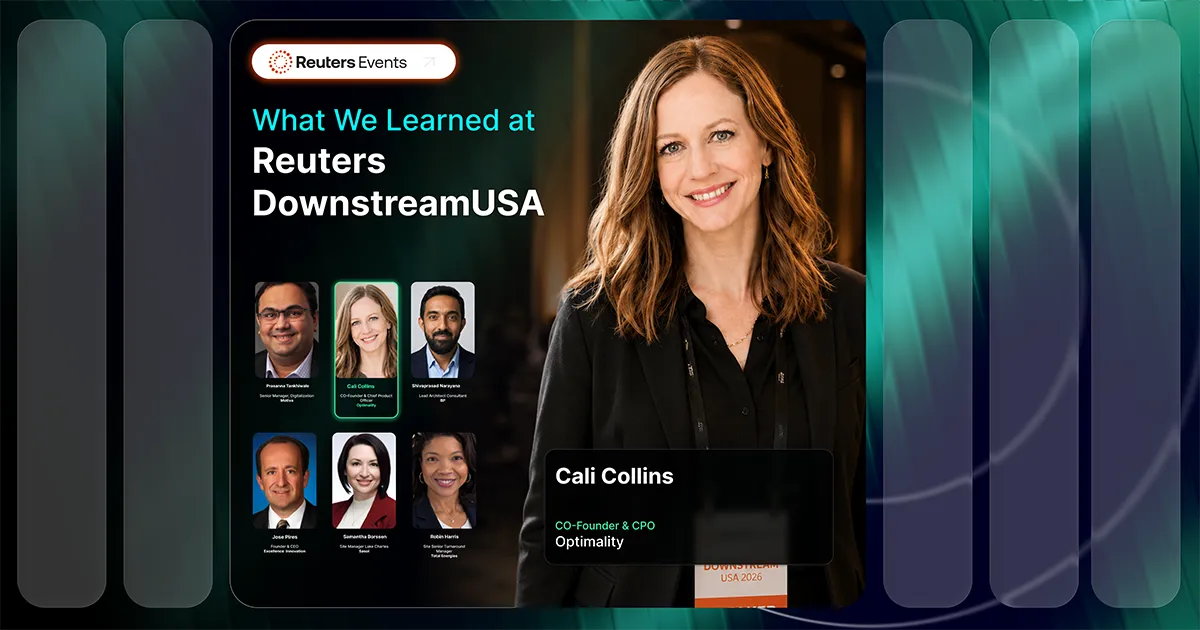
At Reuters Downstream USA, one message came through consistently across conversations with operators, EPCs, technology providers, and digital leaders: the challenge is no longer whether organizations will adopt AI—it's how they will adopt it responsibly.
The industry has clearly moved beyond experimentation. AI is becoming an expected capability within enterprise software, yet many organizations are still struggling with how to integrate it into their daily operations without creating new silos, introducing security risks, or increasing complexity.
Several themes emerged repeatedly throughout the conference.

Trust Is Becoming More Important Than AI
Organizations are not asking whether AI is powerful enough. They already know it is.
Instead, they're asking:
- Can we trust it with our intellectual property?
- Who controls our data?
- How do we govern AI decision-making?
- How do we safely integrate AI into existing business processes?
These are no longer technical questions—they are business and governance questions.
The companies that succeed with AI will be those that build trust through transparency, governance, and human oversight.

AI Is Becoming Infrastructure
One of the more interesting observations was that organizations are no longer searching for "AI software."
Instead, they are purchasing software that solves real business problems—and increasingly expecting AI to simply be part of the experience.
Just as cloud computing quietly became a standard capability, AI is following a similar path. Users care less about the model itself and more about whether it helps them make better decisions, reduce manual work, and improve outcomes.
The Next Challenge Is Connecting AI Together
Many organizations are implementing AI in individual applications:
- Project management
- Procurement
- Document management
- Maintenance
- Scheduling
- Reporting
Each application becomes smarter individually, but they rarely share knowledge with one another.
The next evolution isn't another AI application—it's creating a trusted organizational knowledge layer that allows people, systems, and AI to operate from the same context.
Rather than replacing existing enterprise systems, this approach enables them to work together more effectively.
Simplicity Wins
One unexpected takeaway was how many organizations assumed enterprise AI platforms required months of consulting, complex implementations, and significant infrastructure investments.
There is growing demand for solutions that can start small, deliver value quickly, and expand over time.
Reducing implementation friction may ultimately be just as important as adding new features.
AI Should Augment People—Not Replace Them
Perhaps the most encouraging conversations centered around the role of humans in an AI-enabled organization.
Rather than asking how AI could replace jobs, discussions focused on how AI could:
- prepare information
- surface insights
- identify risks
- recommend actions
- preserve organizational knowledge
while leaving important business decisions in the hands of people.
This "human-in-the-loop" approach reflects a growing recognition that the future isn't about autonomous organizations—it's about enabling people to make better decisions with better information.
Looking Ahead
The conversations at Reuters Downstream USA reinforced what we've believed from the beginning:
The future of industrial AI will not be defined by individual AI tools.
It will be defined by how effectively organizations connect their people, processes, enterprise systems, knowledge, and AI into a single trusted operating environment.
That future requires more than intelligent software. It requires governance, transparency, context, and collaboration.
Those are the challenges we are focused on solving—and we're excited by how closely the industry's conversations are beginning to align with that vision.