


TL;DR
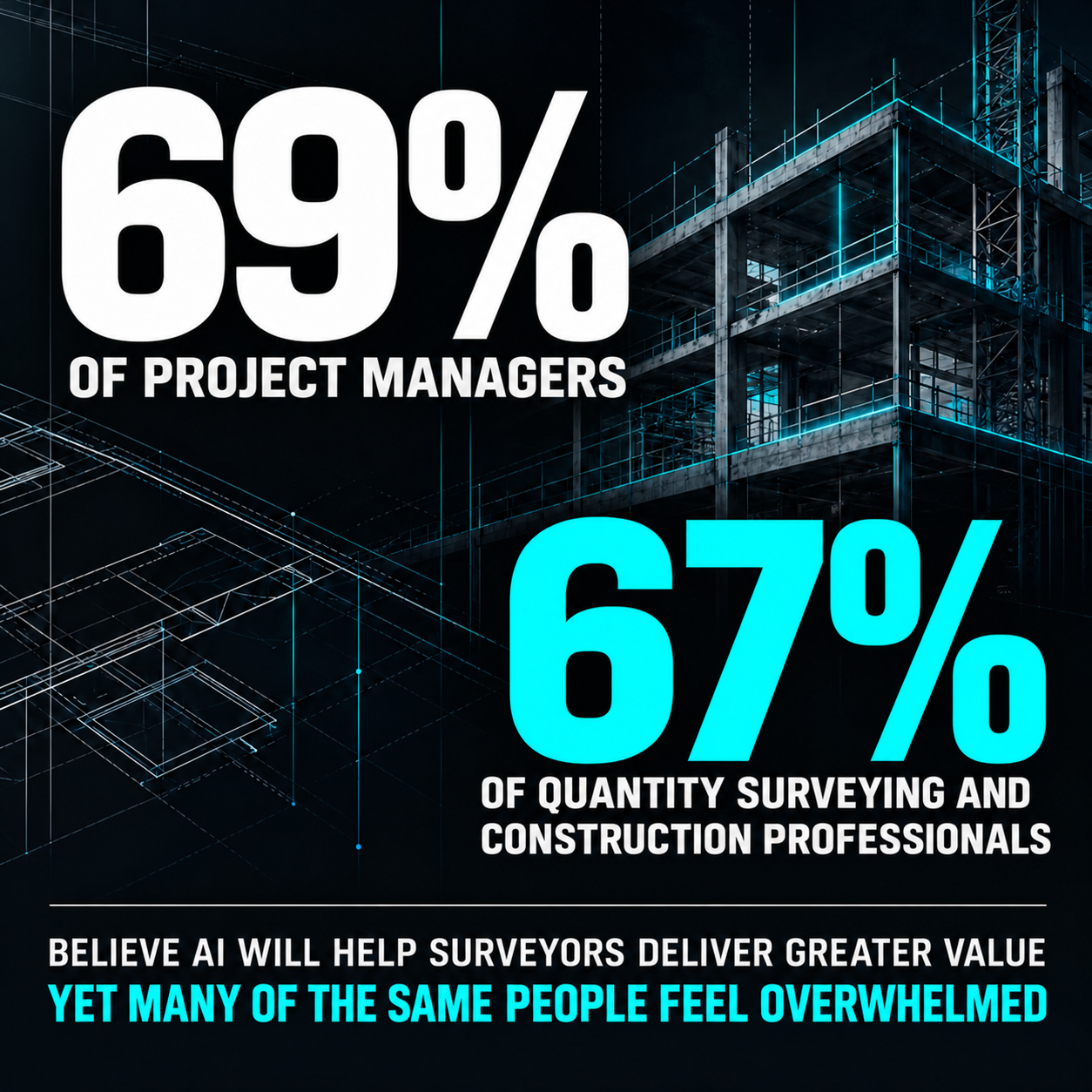
I do not think construction has an AI enthusiasm problem. The profession can see the potential clearly. Recently, RICS found that 69% of project managers and 67% of quantity surveying and construction professionals believe AI will help surveyors deliver greater value. Yet many of the same people feel overwhelmed by the pace of technological change and concerned about what AI means for their own roles.
That is the paradox. Companies are preparing to invest in AI faster than they are preparing people to use, challenge and govern it.
The answer is not another generic course in prompting. Construction needs practical, role-specific learning inside real work so people can understand where AI helps, where professional judgment remains essential and who is responsible when its output influences a decision.

Optimism is not the same as readiness
The debate about AI in construction is often presented as a contest between enthusiasts and sceptics.
I think that misses what is really happening.
I'm pretty sue most construction professionals are capable of holding two reasonable views at the same time. They can believe AI will become valuable while at the same time feeling uncertain about how it will change their work.
Recent RICS research captures this tension particularly well. Sixty-nine percent of project managers and 67% of quantity surveying and construction professionals agreed that AI would help surveyors deliver greater value.
Yet 48% of project managers and 41% of quantity surveying and construction professionals said they felt overwhelmed by how quickly technology was changing the profession. Concern about personal roles was also substantial: 44% among project managers and 38% among quantity surveying and construction professionals.
I would not describe that as resistance. It is a rational response to a technology whose capabilities are moving faster than many organisations can explain how work, authority and professional responsibility will change. And the impact on the individual - "what does it mean for me?"
Construction believes in AI. It does not yet feel ready for it and people need to know how it fits in their own work processes.

Investment is beginning to outrun capability
The wider RICS survey, based on more than 2,200 responses, shows how early the transition remains.
Forty-five percent of respondents reported no AI implementation in their organisations while a further 34% remained in early pilots. Fewer than 12% reported regular use within a specific process, while only 1.5% reported use across several processes. Organisation-wide deployment was below 1%.
The most common barrier was not a lack of potential applications. What was highlighted was a lack of trained or skilled people, this was selected by 46% of respondents. Integration with existing systems followed at 37%, with data quality and availability at 30%.
What interests me is that investment is not waiting for the skills problem to be solved. RICS identified a 16-percentage-point gap between organisations planning to increase investment and those reporting current adoption. And amazingly. around 30% of respondents who named skills shortages as their main barrier still expected their organisations to increase AI investment during the following year.
Investing before every capability is in place is not necessarily wrong but it clearly needs a plan. The problem begins when buying the technology is treated as the transformation in itself and preparing the workforce becomes an informal expectation. Any change to work methods need support to help people adjust to the new tools. This is normal for any enterprise software adoption, AI or not.
Autodesk’s 2025 research points in the same direction. Nearly two-thirds of the organisations it surveyed across Design and Make industries reported a skills gap. Forty-eight percent of professionals said their organisations lacked the resources to create internal training programmes. At the same time, 46% of leaders said AI skills would be a hiring priority over the following few years.
Recruitment will help, but it cannot carry this transition alone. There will not be enough candidates who already combine construction experience, sound professional judgment, data literacy and practical AI competence.
Most companies will need to develop that combination in the people they already have and setup clear development programs to support the transition.
AI literacy is too small an ambition
It seems that many AI training programmes start with useful basics: how generative AI works, how to write a prompt, how to protect confidential information and how to check an answer for obvious mistakes.
Those foundations matter but they are not enough for professional construction work.
A planner does not simply need confidence using a chatbot. The planner needs to know when AI can support schedule analysis, which assumptions govern that analysis, how its conclusions should be tested and what remains under the scheduler’s authority.
A quantity surveyor needs more than the ability to summarise a contract. They need to recognise when a model has missed an obligation, confused an instruction with an approved change or presented an inference as fact.
A construction manager needs to judge whether a recommendation reflects current workface conditions, accepted engineering information and the constraints that determine whether work is genuinely ready.
These are questions of professional competence.
AI can examine information quickly and consider more options than a person could manage manually. But it does not remove the responsibility to understand the source, test the reasoning and own the decision.
The goal should be practical AI competence, not basic AI literacy.
People learn through consequences
And of all industries, construction is a physical and practical one where judgment is developed not only through formal knowledge but from exposure to real situations.
People understand why a planning rule matters when they see the downstream effect of ignoring it. They also learn to recognise commercial risk when a seemingly minor instruction changes cost or entitlement. They quickly learn when an optimistic update is unreliable because they understand the physical conditions behind it.
AI education should build on the same principle.
Give professionals controlled opportunities to use AI on recognisable work. Ask them to compare a document revision, prepare a risk hypothesis, review a progress narrative or trace the possible consequences of a delayed deliverable.
Then require them to inspect the sources, challenge the answer, identify uncertainty and decide what evidence would be needed before anyone acted.
This is more valuable than teaching a catalogue of prompts. Models, interfaces and prompting techniques will continue to change. The durable skill is knowing how to frame a professional question, establish trustworthy context, evaluate an answer and understand the consequences of being wrong.
PMI’s 2025 research supports this learning model. Advanced users were more likely to experiment frequently and use a wider range of learning methods. The difference was not simply access to a better tool. It was preparedness combined with repeated initiative.
Organisations should make that experimentation safe instead of leaving every employee to improvise privately.
Role clarity is part of the training
Skills programmes tend to focus on what AI can do. They should devote equal attention to who remains responsible.
For every use case, teams need clear answers:
- Which information may the AI use?
- Which sources remain authoritative?
- What may the system draft, recommend or execute?
- Which assumptions and uncertainties must be disclosed?
- Who verifies the result?
- Which transitions require human approval?
- What evidence should be preserved?
- What happens when the context changes or the answer is wrong?
This does not slow adoption. It gives people enough certainty to participate in it.
A fluent AI response can look complete long before it is professionally reliable. The person using it must know whether they are requesting an idea, an analysis, a draft or a decision-ready recommendation. Those are different levels of work and should have different standards of verification.
Training cannot be delegated to one department
Workforce preparation is sometimes treated like conventional software training. A learning team is asked to provide a course, technology manages access and business leaders wait for productivity to appear.
AI cuts across those boundaries.
Business leaders must decide where AI should create value and which risks are acceptable. Experienced practitioners must define the standards of evidence and judgment within their disciplines. Technology and security teams must provide safe access. Project leaders must create room for practice, feedback and controlled experimentation.
Learning specialists can help turn those requirements into a programme people can use, but they cannot define professional competence on behalf of the business.
I would begin with a small number of real activities. Define the current method, the accountable role and the evidence of a good outcome. Introduce AI into that setting. Observe where it saves time, where it creates confusion and which new judgments the professional must make.
Improve the method before expanding it.
What I think construction leaders should ask now
The RICS findings do not make a case for waiting until everybody feels ready. Readiness will develop through use.
They do make a strong case for treating workforce capability as part of the AI investment.
I would ask:
- Which professional activities matter enough to improve and are bounded enough to learn from safely?
- What construction knowledge must someone already possess before using AI for that activity?
- What additional AI, data and verification skills does the activity require?
- Which decisions remain human-owned, and how will that ownership be visible?
- How will the organisation capture errors, useful methods and changes in practice?
- Are people being given time to learn, or merely another tool and a productivity target?
These questions move the discussion away from course attendance and towards operational competence.
Where Optimality fits
My view is that people and AI learn to work together most effectively when the technology operates inside the context of real, governed work.
An AI Optimizer can support an activity, inspect connected information or prepare an output. The surrounding work still defines the accountable owner, dependencies, constraints, evidence and approval points.
That structure matters. It helps a professional understand what the AI is doing, where its answer fits and what must be checked before the work advances.
The objective is not to remove professional judgment. It is to give that judgment better context and more leverage.
Confidence should be earned through practice
Construction professionals are right to be optimistic about AI. They are also right to feel uneasy when its capabilities advance faster than their organisations explain how responsibility will change.
The sector will not resolve that tension through enthusiasm alone. Hiring a small group of AI specialists will not prepare everybody else to use the technology responsibly.
Confidence will grow when professionals can use AI on meaningful work, inspect what it produces, understand their responsibility and see that the organisation learns from the result.
Companies that do this well will gain more than a trained workforce. They will develop the shared practical competence needed to turn rapidly changing technology into dependable professional value.

Start building practical AI capability in real work
Explore how Optimality connects people, governed work and AI Optimizers in one operational context.
Frequently asked questions
What is the construction AI skills paradox?
It is the gap between confidence that AI will create professional value and low organisational readiness to use it. RICS found strong optimism alongside substantial concern, feelings of overwhelm and a widespread shortage of skilled personnel.
What AI skills do construction professionals need?
They need basic AI literacy plus role-specific skills in framing questions, selecting authoritative sources, evaluating evidence, recognising uncertainty, verifying outputs and retaining responsibility for professional decisions.
Why is generic AI training insufficient for construction?
Generic courses rarely reflect the technical, commercial, safety and governance consequences of project work. Professionals learn more effectively when they apply AI to recognisable activities under controlled conditions.
Should construction companies invest in AI before training their workforce?
Technology investment and workforce development should proceed together. Tools create opportunities to learn, but deployment without defined use cases, accountable owners and verification standards can produce low adoption or unreliable work.
Will AI reduce the need for experienced construction professionals?
AI can reduce time spent searching, comparing, drafting and processing information. Experienced professionals remain essential for understanding project conditions, judging consequences, challenging unreliable outputs and accepting responsibility for decisions.
Sources
- Royal Institution of Chartered Surveyors, Artificial intelligence in construction report 2025, 2025.
- Autodesk, State of Design & Make 2025, 16 April 2025.
- Project Management Institute, The Project Professional’s GenAI Journey: From Quick Wins to Leading the Transformation, March 2025.