


AI can improve the tools. Execution is the real test.
McKinsey's latest research makes a strong case for AI-enabled capital delivery. I believe its findings point to an even larger change: projects will need a shared operational model that allows people, systems and AI agents to understand what must happen next.
By Simon Wright | Founder & CEO, Optimality
Capital-project organizations have spent decades investing in better technology. We have sophisticated scheduling systems, engineering applications, document controls, cost platforms and an expanding collection of dashboards.
Yet delays, cost overruns and poor productivity remain familiar. Teams still expend enormous effort coordinating work across functions, contractors and systems that represent different parts of the same project.
Artificial intelligence will improve many of those systems. It can review documents, test schedule scenarios, identify emerging risks and recommend actions at a speed no project team could match manually.
I believe these capabilities will have an enormous impact. I also believe the industry could repeat a familiar mistake: improving individual activities while leaving the operating model around them largely unchanged.
AI can identify a better option. The harder problem is enabling a project organization to understand the consequences, make the necessary decision and carry that decision through the work while there is still time to act.
That is the deeper opportunity I see in McKinsey's article, Why the Future of Capital Projects Belongs to Digital and AI-Enabled Teams.

The productivity gap demands a different delivery system
McKinsey estimates that global construction spending will rise from $13 trillion in 2023 to $22 trillion by 2040. The industry must absorb that demand while managing higher costs, constrained specialist capacity and increasingly difficult supply chains.
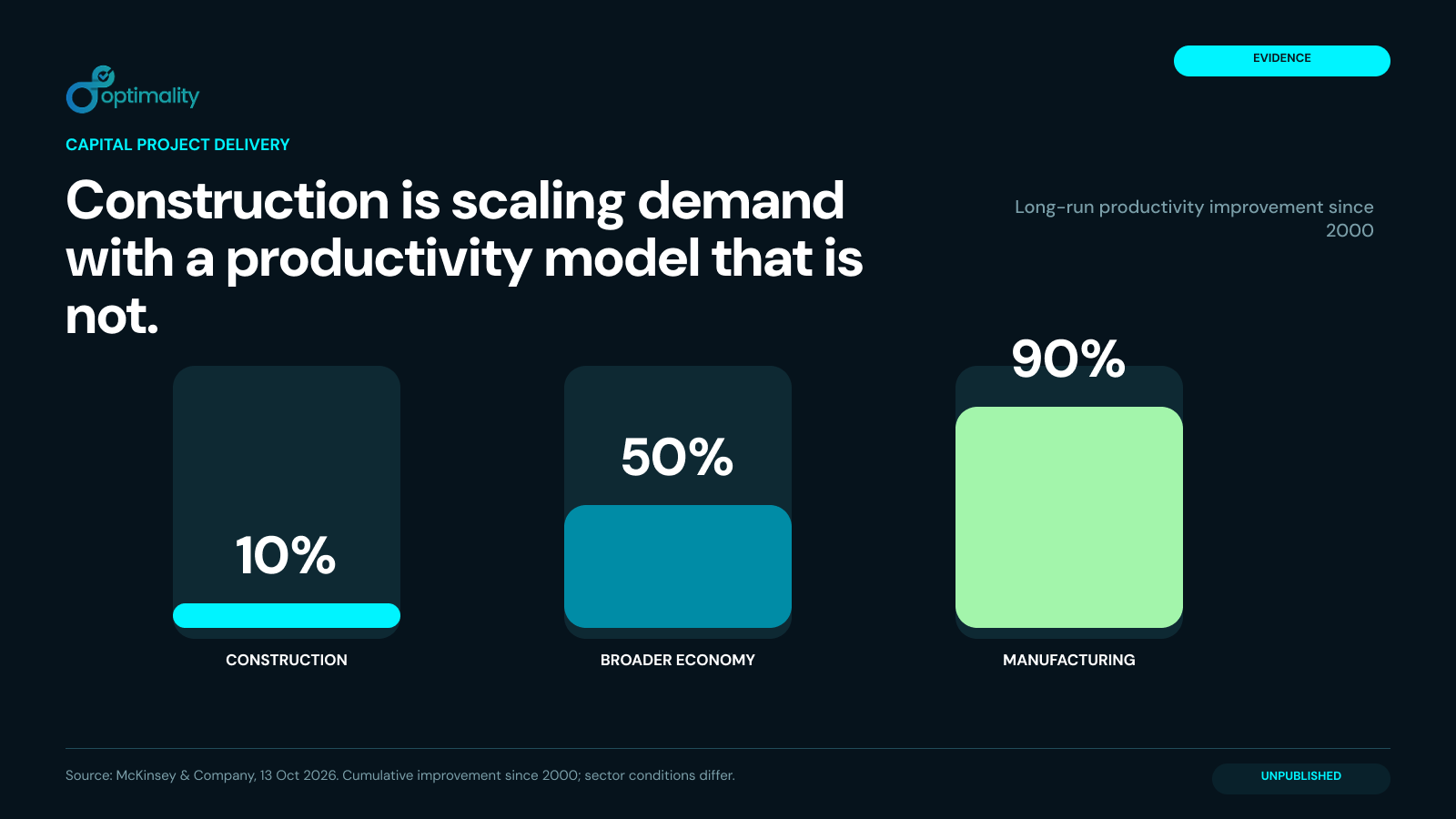
Its long-term productivity comparison is stark. Since 2000, construction productivity has improved by 10%, compared with 50% across the broader economy and 90% in manufacturing.
Those figures do not prove that one technology will close the gap. They show why simply scaling the current delivery model is unlikely to be enough.
McKinsey identifies five domains where digital and AI typically offer the largest opportunity: engineering design and planning; procurement and contract management; construction and commissioning; cost and schedule management; and portfolio management.
Each domain can produce valuable intelligence. Engineering AI can generate and evaluate design options. Procurement agents can detect commercial leakage and supply risk. Field systems can compare reported progress with site evidence. Generative scheduling can test recovery paths. Portfolio tools can reassess value as conditions change.
The larger prize appears when those capabilities stop operating as separate improvements and begin working as one delivery system.
Project intelligence needs to connect to the work
Consider an engineering deliverable that changes during construction.
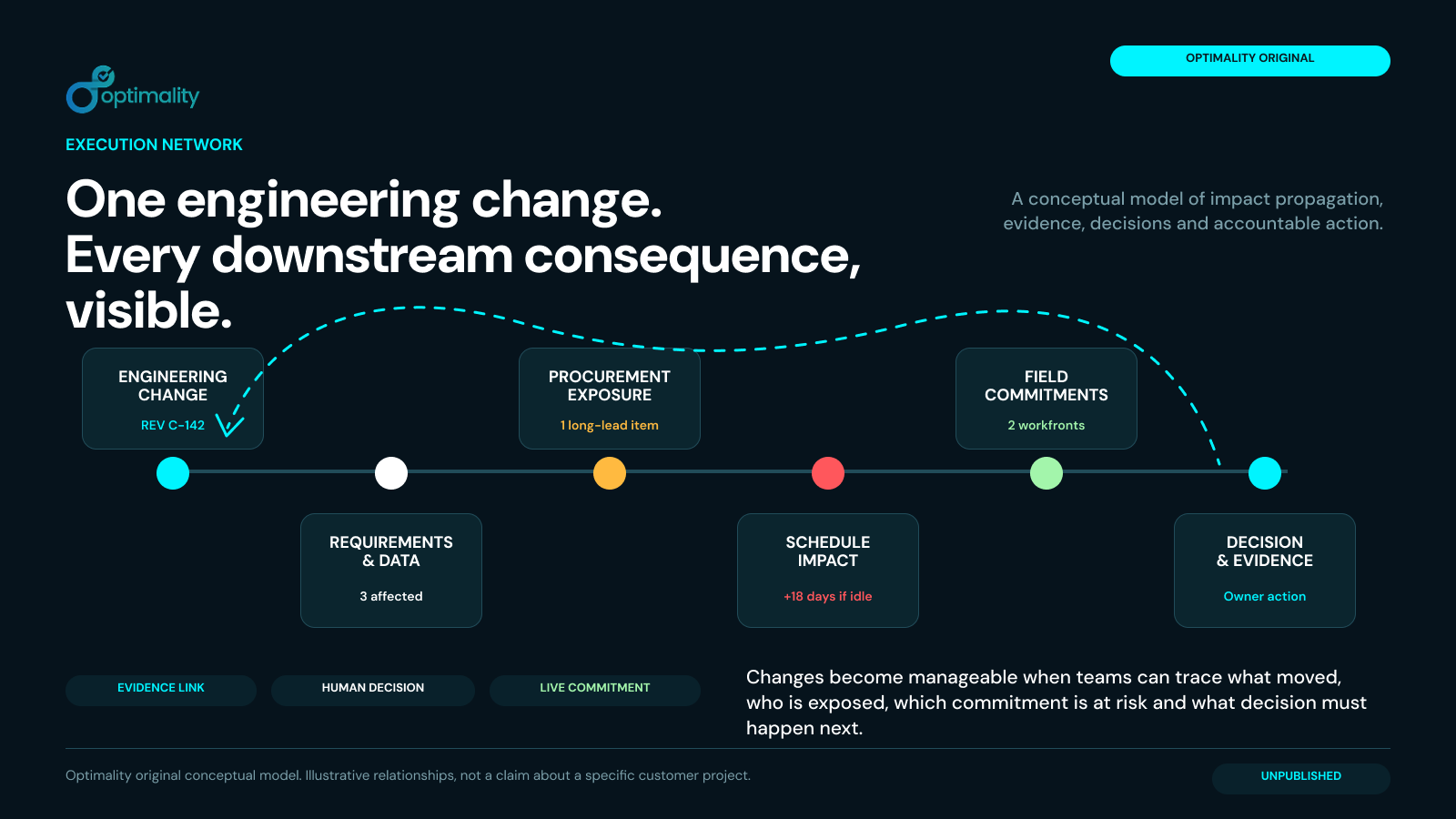
A revised drawing may alter a procurement specification. That change may affect the delivery date of equipment required for a construction work package. The construction team may already have committed people, access and supporting resources to a sequence that now needs to change.
Every function may have an effective system for its own records. Engineering controls drawings. Procurement tracks suppliers and contracts. Project controls maintains the schedule. Construction manages work packages and field commitments.
The difficult question crosses those systems: what does this change mean for the work?
Someone must identify the dependencies, calculate the consequences, understand the available options, establish who has authority to decide and translate the approved response into new commitments. On many projects, this coordination still depends on meetings, email, telephone calls and spreadsheets.
McKinsey describes a related problem as latency. Evidence of a developing issue often exists before the consequence reaches formal reporting. The delay lies in connecting the evidence, interpreting its operational meaning and mobilizing a response.
AI can shorten that delay, but analysis alone does not execute the response. A warning becomes valuable when it reaches the right decision, changes the plan and results in accountable action.

AI needs decision-grade operational context
One of McKinsey's most useful ideas is the need for “decision-grade context.”
Capital-project information is distributed across schedules, contracts, drawings, requests for information, daily reports, procurement systems, work packages and spreadsheets. An AI agent can search and synthesize those sources, but access does not automatically give it a reliable understanding of how the project operates.
Imagine asking an agent whether an engineering change will delay construction. It can examine the drawing, find relevant schedule activities and review procurement records. Its answer may still depend on relationships that are absent from those systems.
Which activities depend on that specific deliverable? What has the field team committed to complete? Are alternative workfronts ready? Who owns the affected decision? Does another contractor need to act first? What evidence will show that the revised plan is working?
Experienced project professionals reason through these relationships every day. Some are documented. Others survive in meetings, local trackers and the working knowledge of the team.
If AI is going to participate meaningfully in project execution, more of that operational context must become explicit, connected and governed. The agent needs to understand more than project information. It needs a reliable model of activities, dependencies, responsibilities, commitments, decisions and evidence.
A future project will combine agents, engines and accountable people
My view is that AI-enabled capital delivery will develop as a collaboration among three different capabilities.
AI agents will interpret information, monitor emerging conditions, reconcile records and propose actions. Deterministic tools will continue to perform the calculations where precision and repeatability matter, including schedule optimization, engineering analysis, quantities and commercial calculations. People will retain authority for decisions involving technical judgment, commercial exposure, safety and organizational trade-offs.
These capabilities need a shared execution context.
In the engineering-change example, an agent could detect the revision and identify potentially affected requirements. Specialist engines could calculate schedule and cost exposure. The project team could compare response options and approve a course of action. The resulting decision would then update the commitments of the people and organizations responsible for execution. New evidence from the work would show whether the response had succeeded or whether the plan needed to change again.
That is a different model from adding an AI interface to an existing application. It treats intelligence, decision and execution as parts of one operating loop.
The role of an Execution Network
This thinking has influenced our work at Optimality.
We use the term Execution Network for a shared model that connects activities, tasks, milestones, data, deliverables, decisions, people, dependencies, commitments and evidence.
The purpose is not to replace specialist enterprise systems. Primavera P6 remains important for planning and schedule control. Engineering, procurement, document-management and commercial systems retain their own authoritative roles.
The opportunity is to connect their signals to the work people are performing.
When a deliverable changes, its relationships provide a starting point for determining which activities, commitments and decisions may be affected. When an agent raises a risk, the network provides context about the responsible people and the work that must respond. When a human approves a change, the resulting commitments and evidence remain connected to that decision.
McKinsey describes the need for technology orchestration across existing applications, AI agents and deterministic tools. I believe the operational model that connects those technologies to accountable execution will become an important enterprise layer.
That is a founder perspective, not a finding reported by McKinsey. It is the direction in which I believe project technology must develop if AI-generated intelligence is going to change delivery outcomes consistently.
Generative scheduling shows both the opportunity and the next challenge
McKinsey reports a compelling example involving a $300 million elevated transit guideway project. Generative scheduling ran hundreds of optimization and risk scenarios, contributing to a 13-month schedule reduction, 20% schedule compression and savings of more than $80 million, or about 25% of project cost.
The result is project-specific, not a general performance promise. It nevertheless demonstrates the value of exploring more options than a team could assess through conventional planning alone.
It also points toward the next challenge.
Optimization can identify a better recovery path. The project organization must still understand what the path changes, secure the necessary decisions, coordinate contractors, revise near-term commitments and verify that execution is following the selected scenario.
Optimization finds a better path. AI-enabled execution helps the organization take it.
From reporting progress to managing what happens next
Project controls will remain essential for baselines, forecasting, governance and commercial accountability. AI does not remove the need for that discipline.
It can help teams act earlier.
A construction team preparing for next week's work needs to know whether engineering information is available, materials are ready, access has been arranged and preceding activities will finish as expected. These questions are familiar to Lean Construction, Advanced Work Packaging and commitment-planning practitioners.
AI can strengthen those practices by detecting missing deliverables, recognizing recurring constraints and comparing alternative sequences. The meaningful test is whether its output changes what happens next.
If a system identifies a problem but nobody owns the response, the project has acquired another report. Value appears when the insight reaches an accountable person, informs a decision and changes execution before the consequence is locked in.

Every project should improve the next one
AI-enabled delivery also creates an opportunity to retain more operational knowledge across a portfolio.
Large projects make thousands of decisions and solve problems that may recur elsewhere. Traditional lessons-learned exercises preserve only a fraction of that experience because they separate the lesson from the conditions, dependencies and decisions that produced it.
When activities, decisions, commitments and outcomes remain connected, a project leaves behind a more useful record. Future teams can examine which constraints repeatedly caused delay, which interventions worked and what evidence supported important decisions.
AI can make that accumulated experience easier to explore, but repeatability depends on the underlying operating model. If every project rebuilds its integrations, definitions and ways of working, the organization will struggle to compound what it learns.
The long-term advantage will come from delivery systems that improve with every project.
Where capital-project leaders should begin
There is no shortage of promising AI applications. Automated document review, generative scheduling, contract analysis and design optimization are already producing worthwhile results.
Leaders should invest in those capabilities while examining the execution system around them.
Start with a coordination problem that regularly affects delivery, such as an engineering handoff, work-package readiness or constraint removal. Make the relationships among activities, information, responsibilities and decisions visible. Establish how an insight becomes an approved action, an accountable commitment and verified evidence. Then introduce AI where it can improve the speed or quality of that loop.
This may appear less dramatic than launching a broad enterprise AI program. It creates something more valuable: a working model that can earn trust, demonstrate value and expand into adjacent workflows.
The organizations that make the greatest progress will not necessarily be those with the most AI tools. They will be the ones whose people, systems and agents can work from the same understanding of what must happen next.
The technology is advancing quickly. The operating model now needs to catch up.
Frequently asked questions
How will AI change capital-project delivery?
AI will help project teams interpret large volumes of information, test more options, detect emerging risks and prepare decision-ready recommendations. Its greatest effect will come when those capabilities are integrated into project workflows that turn insight into decisions, commitments and verified action.
Why are existing project-management systems insufficient for AI-enabled execution?
Existing systems remain essential, but they usually represent different parts of a project independently. AI-enabled execution also requires the relationships among activities, deliverables, dependencies, owners, decisions and commitments so that an identified issue can be understood and acted upon across functional boundaries.
What is decision-grade project context?
Decision-grade project context is the information and operational structure needed to make a reliable project decision. It combines source records with their relationships, dependencies, ownership, timing, constraints and prior decisions rather than presenting isolated documents or data points.
What is an Execution Network?
An Execution Network is a shared model connecting the elements that govern how work is performed, including activities, tasks, milestones, data, deliverables, decisions, people, dependencies, commitments and evidence. It helps teams and authorized AI agents understand how a change in one part of the project can affect work elsewhere.
Will AI replace project managers and project-controls professionals?
AI will automate parts of searching, reconciliation, monitoring, scenario generation and routine analysis. People will remain accountable for decisions involving technical judgment, commercial consequences, safety, priorities and organizational trade-offs. The work will shift toward evaluating options and directing action with better evidence.
Where should a capital-project organization begin using AI?
Begin with a recurring coordination problem where better information can change an important outcome. Define the decision, the required context, the responsible people, the action that follows and the evidence of success. Use that workflow to prove value before extending the model across the portfolio.
Simon Wright is Founder and CEO of Optimality, an AI-enabled work-execution platform that connects activities, tasks, milestones, data, deliverables, knowledge, decisions, people and commitments through a shared Execution Network.
Reference: McKinsey & Company, October 13, 2026. Why the Future of Capital Projects Belongs to Digital and AI-Enabled Teams.