



TL;DR
By Simon Wright
- Better AI-assisted output does not necessarily mean stronger independent judgment.
- Junior colleagues still need meaningful practice, feedback, and opportunities to explain their reasoning.
- Before removing a junior task, identify what it teaches and how that learning will happen afterwards.
Introduction
I was watching a film called "The Electrical Life of Louis Wain", starring Benedict Cumberbatch as an artist and illustrator. It got me thinking about how photography changed the work of illustrators and portrait painters along with the newspapers and magazines industries they were then a part of. We forget the disruption this type of change brings as we continue to go through these technology cycles, and it’s true, some people get left behind. But then others take up the emerging technologies and develop new kinds of work, adapting their skills and training themselves and others to find their place in it as these new jobs get defined.
I think we need to look at AI in the same way. Before treating it as a replacement for junior roles, we need to think about how it can help young people develop. Producing better work is part of that but they also need the experience to understand what AI is doing, challenge it, and eventually take responsibility for it.
I get the feeling companies are about to repeat a problem from the 1970s and 1980s, when apprenticeships declined in Britain. These had been a training ground for many young people entering the workplace. The reasons for that decline were more complicated than companies simply deciding to stop training, but I worry about the same consequence now: fewer opportunities to develop the experience our industries will need later.
It would be a real mistake to let that happen. Companies need to keep some hands-on work for junior people, even when AI could finish it faster, to help with the training. Every industry needs a way to bring new people in and develop them. The apprenticeship principle still matters: people learn through training, experience, and taking on responsibility with someone more experienced beside them as a mentor.
It is difficult to point to one task that teaches you to recognise a wrong answer. Judgment develops over time. You encounter different situations, make mistakes, receive corrections, and gradually learn which details deserve attention. Eventually, you can see that something just does not fit, even before you have worked out exactly why. That gut feeling, isn't just your gut, it's compounded experience you've aquired over time.
If AI removes much of the work through which that experience develops, what will replace it? Who will take over when the current crop of experienced people move on?

Better work does not tell us everything about learning
The question is appearing in professional discussions beyond technology. Recent articles by Ken Rutkowski and Nabiha Khwaja examine what happens to apprenticeship when AI takes over first drafts and routine review. Research is beginning to give that discussion more substance.
A recent working paper studied 133 patent lawyers at eleven US firms over three months. AI assistance did improve drafting quality, but when participants later worked without AI, gains in professional judgment were concentrated among senior lawyers. Junior lawyers showed no average improvement, although their individual outcomes varied. Autor and colleagues, NBER.
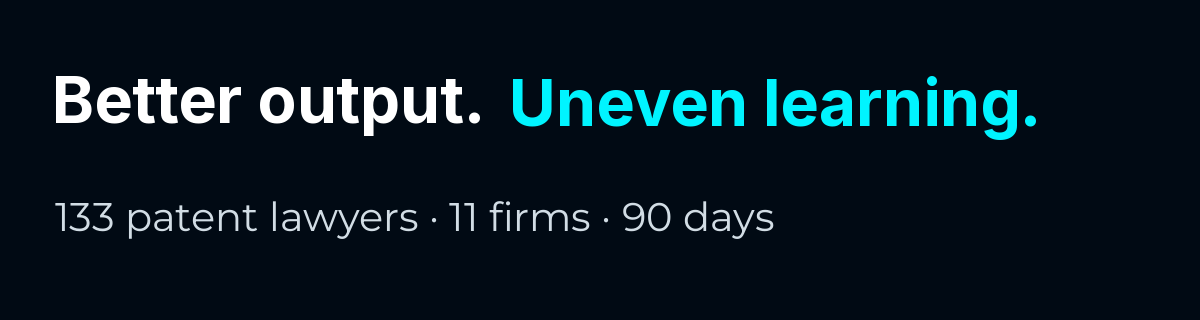
That deserves careful interpretation. It does not show that AI made all junior lawyers worse, or that the same pattern applies in every profession. It suggests that producing stronger work with assistance and developing stronger independent judgment can follow different paths.
A smaller randomised study examined developers learning an unfamiliar Python library. Participants using AI performed worse on a subsequent mastery assessment, while the completion-time difference was not statistically significant. Some ways of using AI, including asking questions to build understanding, were associated with better learning than simply handing over the task. This was a short coding exercise, not a test of an entire career, but it gives us a reason to look at what people understand after the task is finished. Anthropic’s coding-skills study.
For an employer, the useful question is whether someone can explain and defend the work they submit, not just hand it over. A polished result alone cannot answer that or provide the context needed to understand the result.

Be careful about what we preserve
Some junior work has always been repetitive, poorly supervised, and of limited educational value. Spending hours copying information does not automatically make someone more capable. A new generation should not have to repeat every inconvenience the previous generation experienced. We don’t need to train the next generation in exactly the same way as the last. The work itself has evolved.
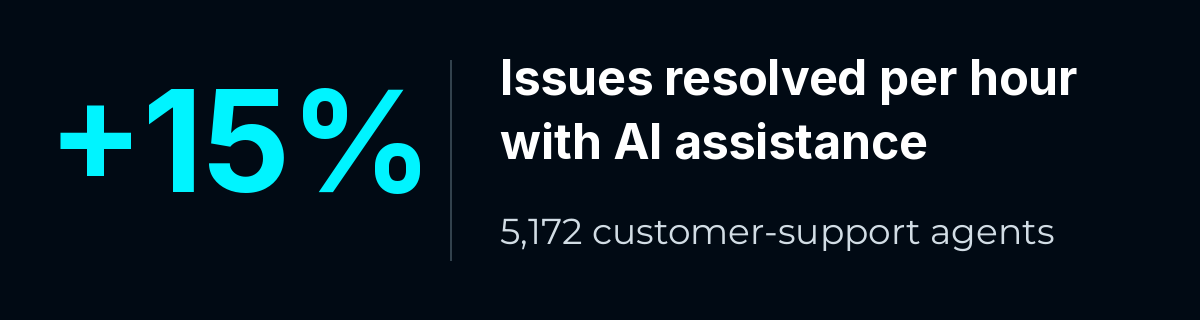
But AI can also help people learn. Research involving 5,172 customer-support agents found productivity improvements and evidence of learning, particularly among less-experienced workers. That setting differs from patent drafting and learning a programming library. A blanket claim about AI destroying expertise would miss those differences. Generative AI at Work.
The decision needs to be made at the level of the work itself. Which activities expose a beginner to useful variation? Where does making an initial attempt help someone understand a correction? Which tasks consume time without developing much understanding?
Those distinctions require someone who knows the work. A general instruction to use more AI, or less AI, leaves the difficult part unanswered.
Make room for an attempt, and for feedback
Take a simple example: a junior planner examining a proposed schedule change. An AI system could prepare a clear explanation of the likely consequences. Reading that explanation may be useful. Asking the planner to form an initial view, compare it with the analysis, and discuss any disagreement could teach something different.
The learning comes partly from understanding what they missed and why it mattered. That requires feedback from someone able to judge both the analysis and the reasoning behind it.
So maybe our way of learning needs to evolve too. I would like to see employers make room to try different approaches. Some assignments could begin with an independent attempt before AI is introduced. Others could use AI throughout, with the junior colleague explaining the assumptions and checking the evidence. As experience grows, the balance should change.
Experienced colleagues also need time to teach. Mentoring becomes difficult to sustain if every review is judged only by how quickly the deliverable moves on. Under immediate pressure, a manager may reasonably choose the faster route while the longer-term development of the team goes unattended.
The responsibility extends beyond today’s output
We will continue to need people who can question an answer, recognise an unusual situation, and take responsibility when the evidence is incomplete. Their judgment will have to come from somewhere.
AI may help us build that capability more effectively than traditional apprenticeship did. It can offer explanations, alternatives and opportunities to practise. Whether people benefit will depend on how those tools are used, the feedback they receive and the experience they accumulate.
My concern is that we could become very good at measuring the work AI helps people finish while paying too little attention to the people we are developing. Bringing junior colleagues into an industry means giving them a path towards competence, including opportunities to struggle with a problem and understand the correction.
Before removing a junior task, I would ask what someone learns by doing it. If the answer matters, we should be able to explain how they will learn it afterwards if the experience is taken away.
Frequently asked questions
Does better work with AI mean people are learning more?
Not necessarily. The research discussed here distinguishes the quality of AI-assisted output from independent judgment or understanding assessed afterwards. Results differ across tasks and levels of experience.
How can employers help junior colleagues develop judgment while using AI?
They can preserve meaningful opportunities to attempt work, explain assumptions, check evidence and discuss corrections with experienced colleagues. The balance between independent work and AI assistance can change as experience grows.
Should employers preserve every junior task?
No. Repetitive work does not automatically develop understanding. Before removing a task, employers should identify what someone learns by doing it and, if that learning matters, explain how it will happen afterwards.
Photo by ThisisEngineering on Unsplash.